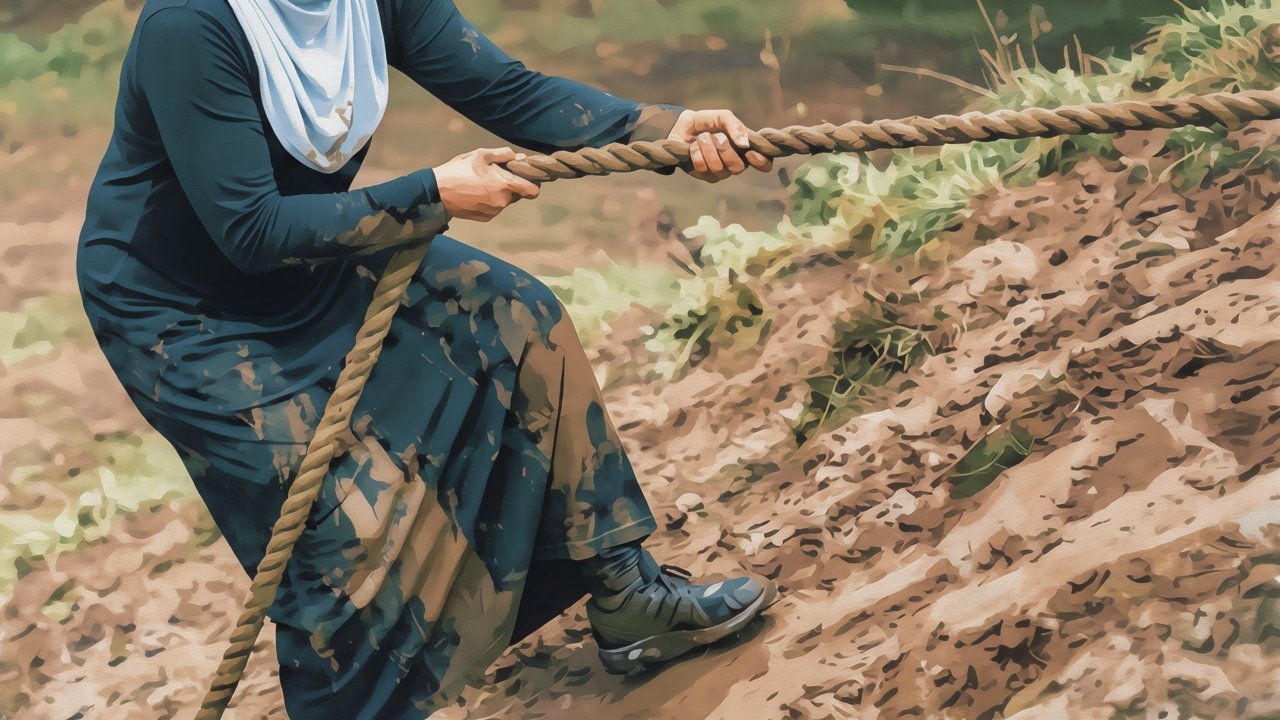
The first thing you notice is the cold floor. Then the early rise, and the long fast stretching ahead. By the time the mud arrives, you have already been practising patience for hours.
The Trials & Tribulations challenge is more than a physical endurance event. Taken as a whole, it traces a journey through five of the most important values in Islamic teaching. Running through all of it, quite literally, is a rope.
The rope
On an assault course, the rope is what gets you up the slippery bank. It is what you grip when your feet slide from under you, and what steadies you as you cross muddy water or haul yourself over a tall fence. Nobody on the course is ashamed to reach for it. Nobody tries to do without it.
Allah says: “And hold firmly to the rope of Allah all together and do not become divided.” (Al ‘Imran, 3:103)
We say it often, and it is easy to let it become an abstraction. The challenge turns it into something your hands can feel. The rope does not make the bank less slippery or the water less cold.
It holds you while you do the climbing. And it holds many people at once: sisters gripping the same line, steadying one another as they go.
Sabr: patience
The challenge asks for patience at every turn: the cold floor, the early rise, the long fast, the muddy obstacles, the waiting for food. But this is not passive endurance. It is an active, conscious orientation of the heart, a decision made again with each step.
“Indeed, with hardship comes ease.” (Ash-Sharh, 94:6)
The verse says with hardship, not merely after it. The ease is already travelling alongside you, and sometimes it takes the form of a rope.
Tawadu’: humility
The course puts everyone on an equal footing, whatever their background, status or ability. Mud does not discriminate. The shared struggle strips away everything that usually separates us and reveals what remains: sisters in need of one another, and entirely dependent on Allah for strength.
There is a particular humility in letting someone pull you up, and in being the one who reaches back down.
Tazkiyah: purification
The mud is a rich symbol. It covers you completely, and then it is washed away. So it is with life’s trials: faced with the right intention, they purify and elevate the soul. Every hardship a believer endures with patience erases something that weighed on the heart.
You come to the course clean and you leave it filthy, but the cleansing that matters is the one that cannot be seen.
Tawakkul: trust in Allah
Completing the challenge requires trusting not just in your own body, but in Allah’s sustaining help. You tie your camel, as the Prophet ﷺ taught, and then you trust. You do everything within your power, and the rest is placed in His hands.
This is precisely what refugees exercise every day: a trust that is not chosen but wrested from circumstances that allow no alternative. The challenge offers participants only a glimpse of what that trust costs, and what it yields. It would be wrong to claim more than a glimpse. But it is an honest one.
Shukr: gratitude
Perhaps the most consistent thing participants report afterwards is a quiet, deep gratitude: for health, safety, food and home. It is not a gratitude that lectures or compares, but one that reshapes ordinary life. The hot meal. The warm bed. The morning prayer in a place of safety.
These things were always blessings. The challenge simply makes them felt.
The onward journey
When the course ends, the physical rope is left behind. But the lesson is not meant to stay on the field. Patience, humility, purification, trust and gratitude are the strands of a different rope, and we are asked to keep hold of it long after the mud has dried.
Some of us will carry it through easy years, and some through very hard ones. Some, like the refugees we run for, are gripping it now, in conditions we can scarcely imagine. We hold it together, and we do not let go.