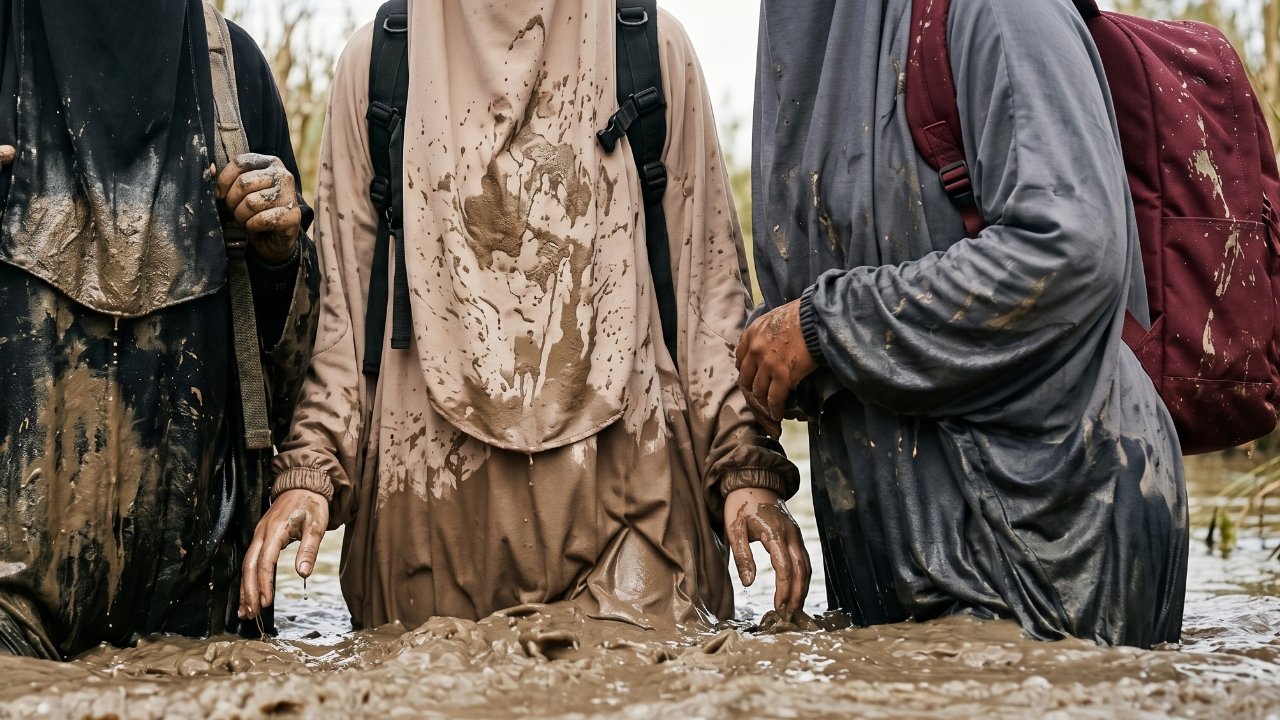
As people of faith, our hearts naturally incline towards justice, towards mercy, towards the easing of another’s suffering. The Qur’an calls us again and again to feel with the oppressed, to stand with the displaced, to remember those who hunger whilst we feast. Yet how often do these inclinations remain abstractions: noble sentiments that live in our minds but never quite reach our bones?
We know refugees exist. We see their images, read their statistics, hear their stories filtered through news reports and charity appeals. We feel sorrow, perhaps donate, certainly make dua. But the distance remains: the comfortable gap between knowing about suffering and knowing suffering, between sympathising from safety and standing in the cold reality of displacement however briefly.
The Trials & Tribulations challenge offers something different: an invitation to close that distance, to move empathy from concept to embodied experience, to walk quite literally in shoes that tread through mud and cold water whilst the body weakens from fasting and the will wavers under exhaustion.
When understanding lives in the body
There is knowledge that comes through study and knowledge that comes through experience. You can read about hunger, but fasting teaches you its hollow ache in ways no description can. You can hear about refugees walking for days, but your own legs trembling after hours on difficult terrain whisper truths that statistics cannot convey. You can imagine displacement’s disorientation, but feeling lost and cold and uncertain where the path leads — even for a few hours, even by choice — creates understanding that sympathy alone never reaches.
This is not to claim that a single day’s chosen difficulty compares to years of forced displacement. The gulf remains vast, unbridgeable. But something shifts when empathy moves from mind to muscle, when solidarity costs actual discomfort rather than comfortable concern. The refugee’s experience stops being abstract tragedy and becomes — however partially and inadequately — something felt in your own cold limbs, empty stomach and exhausted persistence.
The challenge asks you to fast whilst trekking through countryside, then to face obstacles designed to test resolve when the body most wants rest. It asks you to be cold, tired, hungry, uncertain. It asks you to continue when instinct suggests surrender, to persist when comfort calls you to stop. These hours mirror — in pale echo — what refugees endure not by choice but by necessity, not for a day but for weeks or months or years.
The pattern our Prophet walked
The Prophet Muhammad ﷺ knew hunger intimately. He tied stones against his stomach to dull the ache of days without food. He knew exhaustion — the weariness of travelling between cities on foot, of sleeping on hard ground, of facing hostility and opposition that never seemed to rest. He knew displacement: forced from his beloved Makkah, migrating to Madinah, understanding what it means to leave home not by preference but by survival’s demand.
Yet these trials never hardened his heart. If anything, his own difficulties refined his compassion, made him more attuned to others’ suffering, more quick to ease hardship wherever he encountered it. His life teaches that experiencing difficulty can either embitter or soften us — and the difference lies in whether we let hardship turn us inward toward our own comfort or outward toward those whose hardships we now better understand.
When you undertake this challenge whilst fasting, you walk in a tradition the Prophet ﷺ established — using physical difficulty as spiritual discipline, letting hunger sharpen rather than dull your awareness, allowing exhaustion to strip away pretence and reveal what truly matters. The cold water, the mud, the obstacles become teachers if you let them, whispering lessons about patience, about persistence, about finding strength you didn’t know you possessed.
What Allah promises the patient
“Indeed, the patient will be given their reward without measure.” (Surah Az-Zumar: 10)
Sabr — this beautiful, complex concept we translate inadequately as patience — means more than merely waiting. It means persisting through difficulty without complaint, accepting hardship without bitterness, continuing forward when every instinct suggests retreat. It means recognising that some paths require traversing difficult terrain, that growth often comes through challenge, that ease is not always what the soul most needs.
Refugees demonstrate sabr of the highest order. They persist through circumstances that would break many, carry hope through valleys of despair, maintain dignity when the world strips away everything but their humanity. Their patience is not passive acceptance but active endurance: choosing to continue, to survive, to seek safety for their children even when the journey seems impossible.
When you undertake this challenge, you practice a fraction of this patience. You choose temporary difficulty that echoes their forced endurance. You exercise the spiritual muscle of sabr: persisting when tired, continuing when uncomfortable, maintaining resolve when the body protests. This practice matters not because it makes you strong but because it makes you understand, in your bones and breath, what refugees draw upon daily just to survive.
The call to solidarity
This challenge is not adventure or fitness goal or personal achievement to celebrate. It is invitation to embodied empathy, to chosen discomfort that connects you however inadequately to those who cannot choose comfort. It is spiritual discipline that uses physical difficulty to refine the heart, to soften pride, to remember that your ease is not universal and your safety is not guaranteed.
Sign up with pure intention. Not to test yourself or prove capability, but to stand with refugees in the only way available to you: by choosing for one day a shadow of what they endure without choice for years. Let this difficulty humble you, teach you, connect you to realities you might otherwise comfortably ignore. Let your cold limbs pray what words cannot, let your empty stomach remember those who hunger without knowing when they will eat next, let your exhaustion honour those who must persist whether exhausted or not.
You will be pushed physically. The obstacles will challenge you, the fasting will weaken you, the cold water will shock you, the distance will test you. But you will emerge — insha’Allah — spiritually elevated, carrying in your body knowledge you could not gain through sympathy alone. You will understand, however partially, what refugees face. You will carry that understanding forward, let it shape how you see their struggles, how you respond to their needs, and how you honour their resilience.
This is tawakkul — trusting that Allah will carry you through difficulty, that He provides strength when yours runs out, that choosing hardship in His cause and in service of His creation is never wasted effort. This is gratitude made tangible — recognising your blessings by choosing to set them aside temporarily, by facing willingly what others face unwillingly, by refusing to remain in comfortable distance from the ummah’s suffering.
For those who can gather others
To community groups, masjid committees, sisters’ networks: consider organising this challenge in your locality. Create space for your community to experience together what refugees face alone. Let this be opportunity to bond through shared struggle, to inspire one another toward embodied empathy, to raise crucial funds whilst raising awareness that statistics alone cannot convey.
When you bring sisters together for this challenge, you offer them more than event or activity. You offer transformation: the chance to move solidarity from concept to commitment, to practice patience under difficulty, to discover strength through necessity, to honour refugees not merely through words but through willingness to taste, however briefly, the hardship that defines their days.
The invitation
Take that first step, dear sister. Sign up not because it will be easy or enjoyable, but because it matters, because refugees deserve more than sympathy from safe distance, because your heart’s natural inclination towards justice requires more than good intentions to fulfil.
The challenge will be difficult. Your body will protest, your comfort will be sacrificed, your limits will be tested. But you will walk — muddied, exhausted, humbled — in shoes that tread where refugees tread. You will carry in your memory not just intellectual knowledge of their struggles but embodied understanding that shifts how you see them, how you honour them, how you stand with them.
This is where hearts incline when given opportunity to do more than feel. When empathy moves from mind to muscle, when solidarity costs comfort, when the distance between knowing about suffering and knowing suffering closes to the width of chosen difficulty, cold water, hungry persistence, and the refusal to remain comfortably apart from those who have no choice but to continue.
May Allah accept our efforts, multiply our intentions, and ease the suffering of those whose shoes we walk in for only a day whilst they walk in them for years. May He soften our hearts through this difficulty, strengthen our resolve through this challenge, and deepen our connection to the displaced who demonstrate sabr we can only hope to emulate.
The path awaits. Where your heart inclines, let your feet follow.