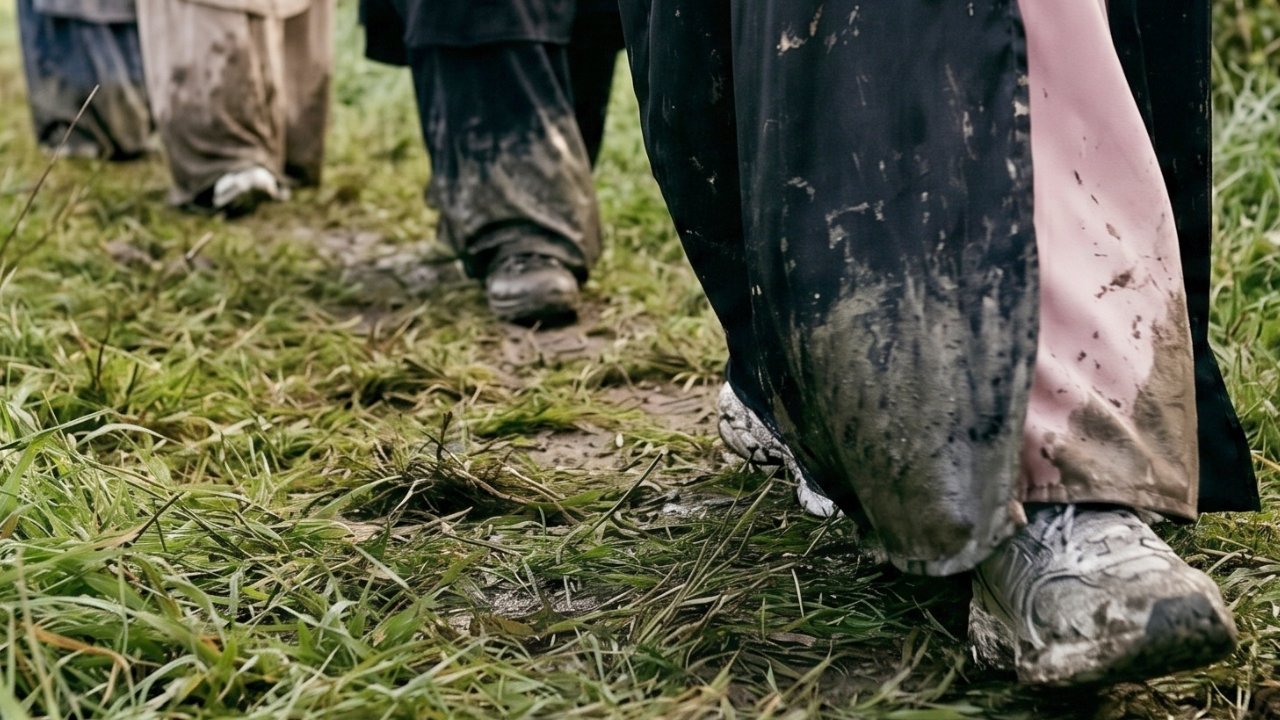
You will face this question, perhaps more than any other: Why must participants wear full Muslim dress for a challenge that leaves them crawling through mud, climbing slick walls, wading through water-filled ditches? Why make something already difficult even harder?
The answer lies in understanding what you are truly offering. This is not a fitness event dressed up in charitable clothing. This is an act of solidarity, a threshold where the comfortable glimpse discomfort, where those who have never known displacement taste, however briefly, what it means to journey without choice.
The modest dress is not an obstacle to overcome but a door to walk through, leading to deeper empathy and truer understanding.
When difficulty becomes the point
Refugee women flee with what they carry on their backs and what they wear on their bodies. They do not pause to change into practical clothing before crossing borders, before wading through rivers, or walking until their feet bleed. Their modest dress travels with them through every hardship, every indignity, every moment when survival demands everything they have.
Those who arrive for your event in elegant abaya and hijab are not costuming themselves for effect. They are stepping into a reality that exists far beyond your course boundaries: a reality where modesty and dignity must be maintained even as the world falls apart around you. The long fabric that catches in the mud, the headscarf that clings when wet, the extra weight of soaked material; these are not design flaws in your challenge. They are the very substance of solidarity you promised.
The discomfort is deliberate. The added difficulty is the lesson itself. You are not making things harder for the sake of cruelty but creating conditions where empathy can take root in the body’s understanding, not just the mind’s abstract sympathy.
Clothing as threshold
Something profound happens when people don traditional modest dress for the Trials & Tribulations challenge. They cross from observer to participant, from sympathiser to witness. The abaya becomes a teacher of its own, whispering lessons with every restricted movement and moment of adaptation required.
As organisers, you must help them understand this transformation before it begins. Speak to them about the refugee women who maintain their modesty through circumstances that would break most spirits, those who refuse to surrender their identity even as everything else is stripped away. These women demonstrate that dignity is not a luxury to be abandoned when survival is at stake but an essential part of what survival means.
They will discover this truth themselves as they move through the challenge. With each obstacle, they will feel in their own muscles what it means to preserve modesty whilst the world demands compromise. They will understand, perhaps for the first time, that strength and modesty are not opposites but allies.
Practical wisdom for those who guide
Your role extends beyond logistics into genuine care for those who trust you with this journey. The right preparation allows people to maintain both modesty and safety; these need never be opposed.
Guide them towards thoughtful layering. The base layer provides foundation: a supportive sports bra, moisture-wicking running leggings, a breathable long-sleeved top. An under-hijab offers security beneath their main khimar. The inner layer adds coverage: black palazzo trousers or salwar over leggings, a tunic that can bear the mud whilst protecting what lies beneath.
For the outer layer, material matters profoundly. Encourage polyester blends and synthetic fabrics that shed water rather than absorbing it, that maintain reasonable weight even when soaked. Warn against heavy cotton that becomes impossibly burdensome when wet, against delicate fabrics that will fail under these conditions.
This is not about making things easier but about making things possible. There is a difference, one you must help people understand, between meaningful difficulty and unnecessary danger. Your wisdom allows them to experience the former and avoid the latter.
When resolve is tested
Midway through your course, when mud clings heavy and water chills to the bone, some will want to tuck their abayas into their waistbands, to lift hems to knee height. Others will consider removing outer layers entirely, continuing in just their inner clothing. This is the moment your leadership matters most.
Gently but firmly, remind them why they came. The refugee women they honour do not have the luxury of adjusting their clothing when the journey becomes difficult. They walk in full modest dress through circumstances far more challenging than any obstacle course, making decisions about dignity and faith with each exhausted step.
The Qur’an promises: “Indeed, with hardship comes ease” (Surah Ash-Sharh, 94:6). They will discover this verse written not just in scripture but in their own experience: how persistence through difficulty births unexpected strength, how maintaining values through trials deepens rather than diminishes them.
Help them stay focused not on proving anything to spectators but on honouring those whose struggles are not performance but daily reality. The abaya becomes not a burden to escape but a teacher to walk with, a reminder that they can endure whilst staying true to what matters most.
The transformation you offer
As organisers, you are architects of more than an event. You are creating a liminal space where transformation becomes possible, where those who have never questioned their comfort must suddenly negotiate discomfort with dignity intact.
In wearing full Muslim dress through mud and exhaustion, people become ambassadors for a truth too often obscured: that modest dress does not constrain but empowers, does not weaken but strengthens. They challenge every lazy assumption about what Muslim women can or cannot do, about what faith permits or prevents.
This is one of your most powerful gifts as organisers, creating space where misconceptions crack open under the weight of lived experience. When spectators see them climbing walls in flowing garments, maintaining hijab whilst crawling through trenches, refusing to compromise their values whilst refusing to compromise their effort, something shifts in how modesty itself is understood.
Those who complete the challenge will be changed by what you have built. They will understand in their bones what mere words could never teach: that refugee women who maintain their modesty through unimaginable hardship are not passive victims but active choosers, not constrained by their faith but empowered by it.
They will learn that solidarity is not sympathy from a distance but standing, however briefly and imperfectly, in circumstances that approximate another’s reality. They will discover that the Muslim dress they wear is not costume but connection, not symbol but substance.
This is the gift your leadership makes possible. This is the sacred work you undertake when you insist that modest dress is not optional but essential to the challenge itself. You are not making things unnecessarily difficult. You are making empathy possible, dignity visible, and strength undeniable.
May your guidance create space for these truths to emerge. May those who walk your challenge carry these lessons far beyond their final obstacle, into lives transformed by one day of choosing, as refugee women must choose every day, to maintain faith and modesty no matter what trials the path ahead demands.