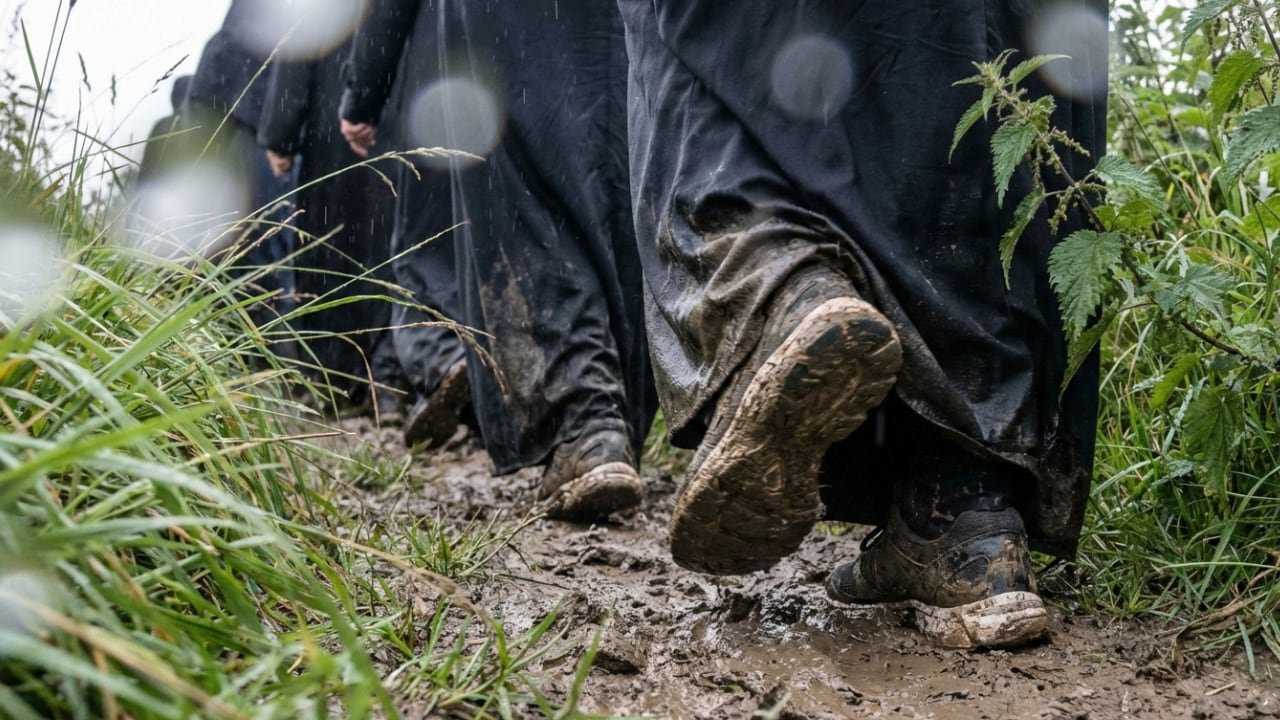
The most profound transformations rarely announce themselves with fanfare. They don’t require centralised administration or elaborate infrastructure. They happen quietly, in small gatherings where sisters know each other’s names, where trust doesn’t need building because it already exists, where the challenge becomes not something imposed from above but something chosen together.
This is why Trials & Tribulations works best at the grassroots level — not as a compromise or temporary arrangement, but as the very architecture of its purpose.
Local ground, deeper roots
When your madrasa, sisters’ circle, or halaqa organises its own challenge, you’re doing more than planning an event. You’re claiming agency, exercising the quiet authority that comes from knowing your community’s needs, capacities, and particular spiritual hungers. The sisters who join you aren’t anonymous participants in someone else’s vision — they’re neighbours, friends, family members whose stories you already hold.
This intimacy changes everything. You know which sister recently lost her father and might find the challenge overwhelming. You understand that another’s husband remains sceptical and needs patient explanation, not pressure. You recognise that a third thrives on difficulty and secretly hopes for something harder than what’s advertised. This knowledge allows you to guide rather than merely manage, to adapt rather than enforce, to serve the transformation happening in front of you rather than chase abstract outcomes.
The skills you develop through organising don’t merely serve this challenge. They spill into other aspects of community life: the confidence to initiate, the competence to execute, the wisdom to evaluate and improve. Leadership emerges not through appointment but through the quiet work of making something meaningful happen. Year by year, sister by sister, your community becomes more capable, more resilient, more alive to its own possibilities.
Money’s proper place
Keep finances simple, local and transparent. When trusted community members handle modest sums directly — booking a minibus, paying a venue fee — suspicion finds no purchase. Everyone knows who’s responsible, where money comes from and where it goes. This simplicity isn’t merely convenient; it protects the work’s integrity.
Centralised fund management invites complications you don’t need. It introduces distance between intention and action, creates opportunities for misunderstanding or worse, shifts focus from spiritual purpose to financial administration. By keeping monetary matters close and clear, you ensure that money serves the challenge rather than defining it.
This approach also liberates us to focus on what we do best: providing guidance, refining understanding, developing resources that help you create experiences worthy of your communities. We’re not fund managers nor event coordinators. We’re fellow travellers who’ve walked this path enough times to recognise where others might stumble, where clarity helps, and where silence serves better than instruction.
Adaptation as faithfulness
Every community carries its own character, faces its own constraints, and holds its own gifts. What works magnificently in Birmingham might miss the mark entirely in Cardiff. The venue perfect for one group might prove inaccessible or inappropriate for another. Sisters in one community might fast comfortably whilst others need different parameters. Some groups thrive on intense physical challenge whilst others find their edge at gentler difficulty.
Local organisers understand these nuances without explanation. You know whether your community needs encouragement to attempt difficulty or permission to scale back. You recognise which obstacles will teach and which will merely punish. You sense when to push and when to accommodate, when to challenge assumptions and when to honour limitations.
This isn’t compromise — it’s faithfulness to the work’s actual purpose. You’re not manufacturing identical experiences across different contexts. You’re creating containers where sisters in your particular community can meet themselves honestly, can choose temporary discomfort as a bridge to understanding refugee displacement. The framework remains constant; only the expression adapts to serve transformation rather than performance.
The gift of repetition
When the challenge becomes an annual rhythm in your community’s life, something shifts from event to tradition, from novelty to expectation. Sisters mark calendars months ahead. First-time participants benefit from accumulated wisdom: your second year’s smoother organisation, your third year’s refined understanding of what actually matters, your fourth year’s quiet confidence in the work’s value.
Each repetition teaches you differently. The first year, you discover what you didn’t know you didn’t know: logistics that seemed straightforward reveal hidden complexity, moments you anticipated as powerful fall flat whilst unexpected encounters shake sisters to their core. The second year, you refine. The third year, patterns emerge. By the fourth, you’ve developed institutional memory, best practices shaped by your community’s particular needs and insights.
Individual sisters grow through this rhythm too. The one who barely completed the challenge whilst questioning her capability returns the following year with quiet confidence. By year three, she’s guiding nervous newcomers through obstacles she once found impossible, offering encouragement from the wisdom of her own struggle.
Some sisters discover that annual participation continues their transformation, each repetition peeling back new layers of understanding about strength, solidarity, faith tested through difficulty. Others find that leading teaches as much as participating; that guiding first-timers through the challenge becomes its own profound education.
This annual repetition builds something larger than the sum of individual events. The challenge weaves into your community’s spiritual and social fabric, becomes part of how you understand yourselves, creates living tradition that evolves whilst maintaining core purpose. Knowledge passes from experienced organisers to newer ones. The work deepens not through expansion but through patient refinement of what you already do well.
Working with established organisations
Larger charities like Islamic Relief and Muslim Hands possess infrastructure and reach that can amplify the challenge’s impact. When they organise events using this blueprint, they introduce sisters to embodied solidarity who might never encounter it otherwise. This serves the work’s larger purpose.
As for our part? We remain guides rather than organisers, providers of frameworks rather than managers of implementation. We don’t handle funds, don’t directly manage events, don’t insert ourselves between communities and their own capacity for meaningful action. We offer outlines, principles, hard-won insights, but trust you to create what your community needs.
The movement you’re building
Trials & Tribulations represents more than a series of events. It’s a quiet insistence that Muslim women can claim agency, can choose difficulty that serves growth, can build solidarity through shared struggle rather than comfortable distance. It’s a recognition that transformation happens most reliably at human scale, in communities where sisters know each other’s names and stories.
By keeping organisation grassroots, you ensure the challenge remains:
- Authentic to its core purpose — embodied empathy with refugees through chosen difficulty
- Sustainable beyond initial enthusiasm — woven into annual rhythms rather than dependent on external energy
- Deeply connected to particular communities — shaped by local wisdom rather than universal prescription
- True to its pedagogical heart — creating space for transformation rather than performing charitable activity
Your role as organiser carries more weight than you might recognise. You’re not merely coordinating logistics. You’re acting as spiritual architect, creating containers where sisters can meet themselves honestly, where abstract empathy transforms into something felt in muscle and breath, where comfortable certainty encounters necessary disruption. This is sacred work, made possible precisely through its local, intimate, grassroots character.
The success of Trials & Tribulations lies in its ability to inspire Muslim women to take initiative, support one another, grow through chosen difficulty. By keeping organisation at the grassroots level, you ensure these essential elements remain at the heart of every challenge — not as aspirational values but as lived reality, practised year after year in communities across Britain.
This is the movement you’re building: one challenge, one community, one transformed sister at a time. May the work continue to deepen, the understanding to refine, the solidarity to strengthen. May what you create serve both those who participate and those for whom you walk: refugees whose displacement you honour through temporary difficulty, whose humanity you recognise through embodied empathy, whose plight you refuse to abstract into comfortable distance.