The garment we choose
Not every Muslim woman wears abaya; this truth needs stating before all else.
Fashion shifts, interpretations of modesty evolve, and preferences change across generations and geographies: some sisters have never worn the long, flowing garments once common at British mosques and markets, others wore them once but no longer do, and still others move between styles depending on context, occasion or comfort. This is as it should be, since Islam offers principles whilst how we embody them varies widely and validly, the choice belonging to each woman according to her understanding, her circumstances and her relationship with Allah.
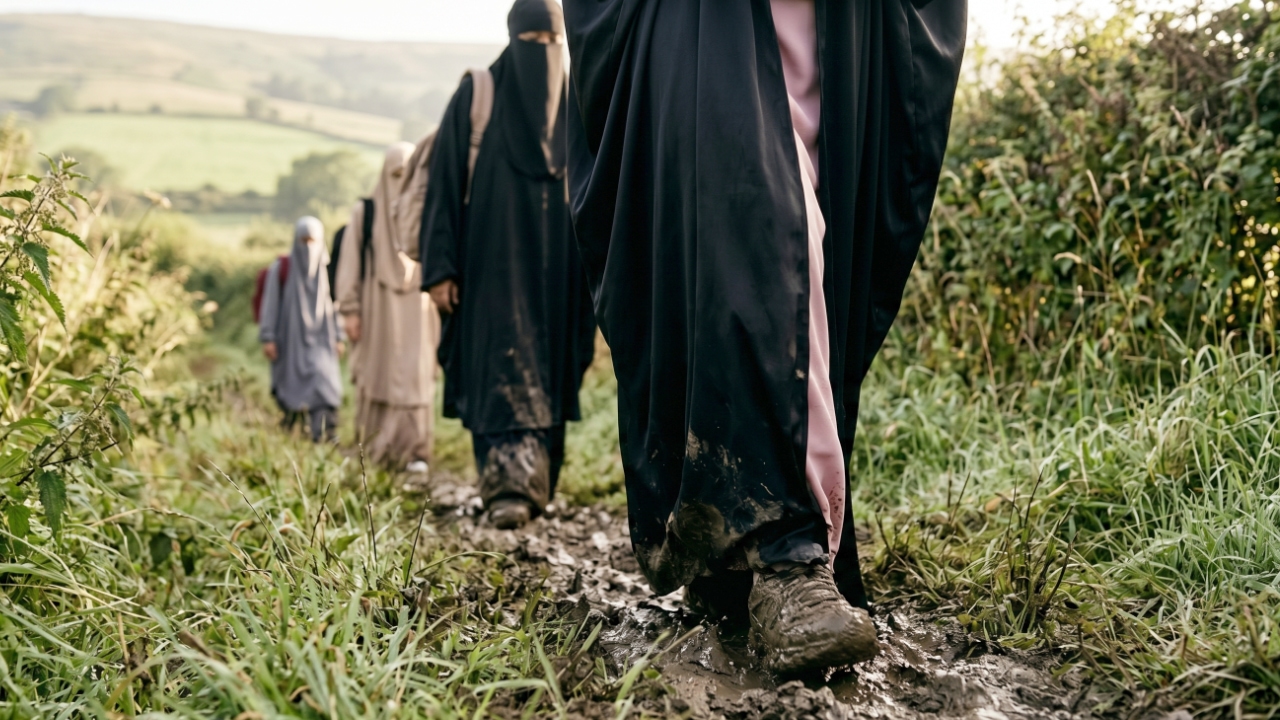
Yet for Trials & Tribulations, you ask participants to wear abaya regardless of their usual practice, not to enforce a dress code or suggest one interpretation supersedes another, but for solidarity — deliberate, visible and embodied. When refugee crises unfold across our screens, in Syria, Gaza, Afghanistan, Myanmar, Sudan and countless other places where displacement shatters lives, we see women fleeing in abayas often enough that the image becomes inseparable from their reality: women wrapped in dark, modest fabric, walking through dust or mud, carrying children, their garments marking them as visibly Muslim even as the world renders them invisible.
You ask participants to wear abaya as an act of solidarity with these women, to be marked as they are marked, to carry for one day what they carry indefinitely, not because it is everyone’s daily practice but because it connects us, however tenuously, to their reality. This is the garment you choose: not a judgement, nor a claim of singular validity, but conscious solidarity with refugee women whose dress announces their faith to a world that does not always welcome the announcement.
Stepping into visibility
When participants arrive at countryside trails, dressed in full abaya and hijab, perhaps for the first time in years or the first time ever, they step into a particular visibility. In fields and forests, on moors and muddy paths, Muslim women in modest dress are rarely a common sight, and your participants may be the only hijabis some walkers encounter that day, or even that year.
Their presence speaks before they do. The abaya flowing as they walk, the hijab wrapped carefully despite knowing wind and rain will test it: this itself is an announcement. To some observers they may seem out of place, as though Muslim women belong in cities rather than on wild hillsides, yet here they are, stepping onto the same paths, embracing the same landscape, showing with every step that these green spaces belong to everyone.
This visibility is far from accidental; it is the point. Refugee women cannot hide their identities, since their dress marks them, sometimes endangering them, always making them seen, and when your participants choose to be similarly visible, they taste the smallest measure of what this costs. They feel eyes on them, whether curious, uncomfortable or hostile, and they notice the double-takes, the stares quickly averted or held too long, or the way some people warm to them immediately whilst others seem to stiffen.
This is dawah of a particular kind: not preaching, explaining or offering answers to questions no one asked, but simply being present, so that their visible Muslim identity in unexpected spaces becomes testimony itself. We are here, we love beauty and nature and adventure, and we belong on this country’s paths as much as anyone, neither separate nor foreign nor confined to the shadows.
The power of joy
What transforms mere visibility into something more powerful is joy: not forced cheerfulness, but genuine delight in the experience, in the crisp air and rolling hills, in the way light filters through trees, in that profound quiet that only the countryside offers.
When people see Muslim women in abayas splashing through mud with laughter, braving rain without complaint, greeting fellow walkers with warm smiles and helping each other over stiles, it disrupts the expectations many carry, in which Muslim women are associated with constraint or restriction or separation. But here they are, muddy and windswept and radiantly happy, embracing unpredictable British weather with the same enthusiasm as anyone else.
Joy breaks stereotypes more effectively than any argument could, communicating without words that we are not passive, sheltered or confined by faith or dress, that we seek the same moments of peace and beauty as everyone else, and find the same pleasure in mud splashing up hems and cool drizzle settling on scarves. This is dawah through authenticity: not trying to convince anyone of anything, but simply being themselves in spaces where their presence quietly challenges assumptions.
Walking with adab
The Prophet Muhammad ﷺ taught that good character, adab, is the heaviest thing on the scales of judgement, and in countryside spaces during the challenge, adab becomes just as important as visibility. Small acts carry disproportionate weight when one is conspicuously Muslim: a cheerful “good morning” to fellow walkers, stepping aside on narrow paths with grace, picking up litter that is not theirs, respecting gates and fences, treating the land with the care Islam teaches toward all of Allah’s creation. These small considerations create impressions that linger, shaping how observers think about Muslims, Islam, and women who dress as your participants are dressed.
This matters because refugee women rarely control the narratives told about them. They are spoken about, depicted in media, and often reduced to victims or threats or statistics, with little chance to demonstrate the good character, dignity and quiet steadfastness that carries their families through impossible circumstances. When your participants walk with good adab, when their kindness and courtesy become inseparable from their visible Muslim identity, they offer a different story — not the whole story, for they cannot speak for refugees or represent their experiences, but one that includes Muslim women as full human beings: kind, considerate, present and engaged with the world around them.
The mud that teaches
There is something profound in mud-splattered abaya, in cold water soaking through layers of fabric, in negotiating stiles whilst managing long skirts. These small indignities, chosen and temporary as they are, connect participants to refugee women’s daily realities in ways words alone cannot.
Refugee women walk in abayas through conditions far worse than British countryside mud, through desert heat and monsoon rains, through border crossings and camp pathways, through circumstances that tear and soil garments meant for far gentler purposes. Yet they maintain modesty anyway, continuing to dress as faith and culture call them to dress even when practicality might argue otherwise. This is dignity preserved under assault, identity maintained when everything else is stripped away, faith made visible even in circumstances that would excuse its abandonment.
When participants’ abayas grow heavy with mud, when rain makes fabric cling uncomfortably, when they find themselves wishing for athletic wear instead, remind them what separates their discomfort from what it echoes: they chose this for one day, comfortable clothes wait at home, and their hardship has a finish line. Refugee women live this reality indefinitely, with no promise of return to easier circumstances, and with identity, faith and dignity the only possessions displacement cannot steal.
The landscape that speaks
As participants walk through countryside, whether fields or forests, moors or meadows, encourage them to let the landscape itself become teacher. The Qur’an repeatedly directs attention to the natural world as evidence of Allah’s artistry, as invitation to reflection, as reminder of something larger than human concerns:
“Indeed, in the creation of the heavens and the earth and the alternation of the night and the day are signs for those of understanding” (Qur’an 3:190).
The hills rolling into the distance, the intricate detail of bark and leaf, the vast sky stretching over small human figures: these speak of the Creator’s majesty in ways mosques and books cannot fully capture.
Refugee women often lose access to such beauty. Camps are crowded and utilitarian, and the landscapes they flee through are marked by danger rather than peace, by borders to be crossed and territories controlled by those who wish them harm, where survival overshadows any thought of beauty. Even when they reach safety, they may find themselves confined to urban areas, far from the countryside that might offer nature’s particular solace.
Your participants’ walk through beautiful landscape is both solidarity and privilege — the privilege of choosing discomfort in safe, beautiful surroundings, knowing help is available if needed, the route planned, the finish line certain. Help them recognise this privilege, and let it soften their hearts toward those who walk uncertain routes with no guaranteed destination and no promise that the journey ends in anything but further displacement.
What they carry forward
When participants complete Trials & Tribulations, muddy, exhausted, having walked miles whilst fasting in full abaya and hijab, they carry forward something written in their bodies rather than in memory alone: a fraction more understanding of what visible Muslim identity costs in spaces where it is unexpected. Those who saw them on the trails will remember — not their names, since strangers never learned them, but the image: Muslim women in abayas, muddy and happy, belonging to these landscapes as much as anyone. Let it make them advocates rather than merely sympathisers, companions on the journey rather than distant observers of suffering, so the understanding this day builds deepens with time and bears fruit in action long after the mud has washed away.
When you organise this challenge, you do more than plan a charity walk. You create a threshold: a liminal space where the comfortable glimpse discomfort, where the fed taste hunger, where the secure feel, however briefly, the vertigo of having no solid ground beneath them. This is sacred work. Your participants will arrive as individuals and walk as a community bound by shared struggle and purpose, discovering that their physical journey mirrors an inner pilgrimage many have neglected to begin. They will learn what refugees already know: that the truest refuge is not found in the absence of hardship but in the nearness of Allah, in that sacred, still space where the displaced heart finally finds rest, where the weary traveller discovers they were never truly lost, only taking the long way home.
May this challenge be a means of drawing closer to the One who is always, always near.