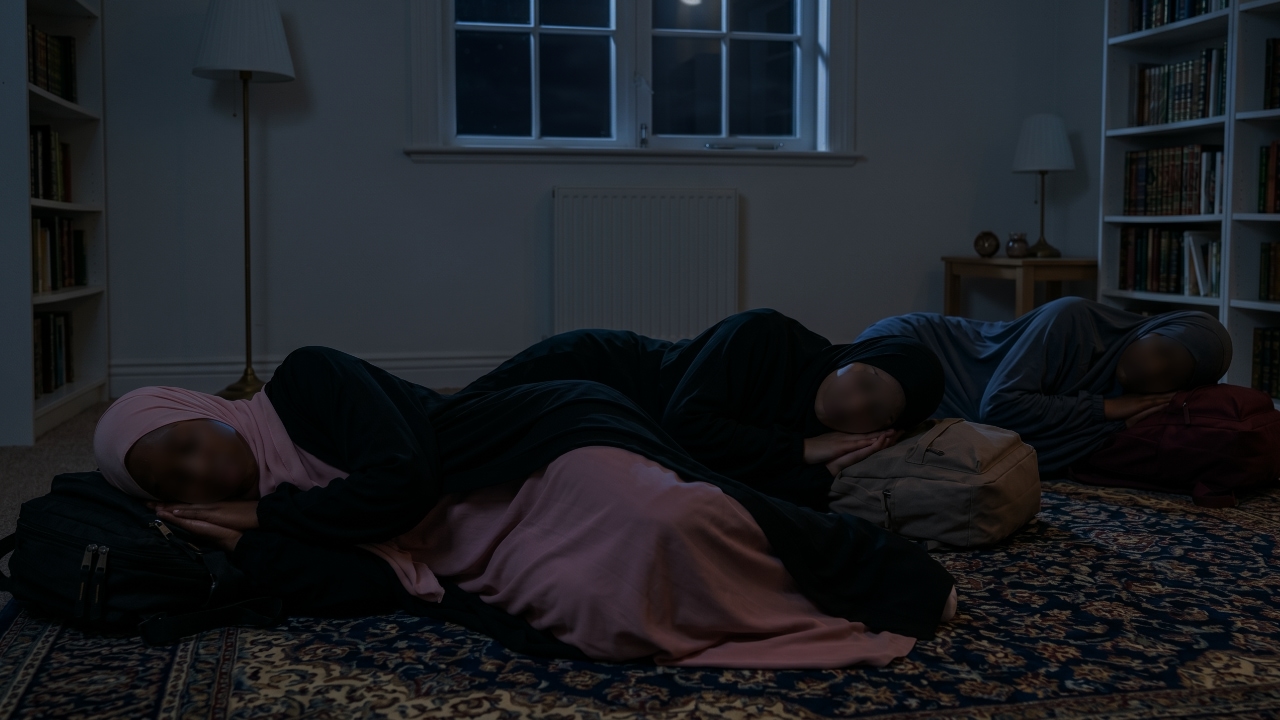
Tahajjud is finished. The room, which held such warmth and movement only minutes ago, settles back into stillness, and now comes the thing none is quite prepared for: the floor.
You lower yourself first. That matters more than you might expect: those that look to you for guidance need to see it done with a kind of quiet acceptance, and to see that there is a way to lie down on cold, hard ground without something in you resisting it.
You arrange your abaya, tuck your rucksack beneath your head, and the floor makes itself known immediately: unyielding, indifferent, honest in the way that only genuinely uncomfortable things can be. The cold presses through fabric with patient insistence. There is no negotiating with it, no position that fully relieves it; in stillness you lie down and let that understanding arrive for others.
Here the sisters follow, one by one. There are the soft sounds of settling — the shift of fabric, the careful exhale of someone discovering that no arrangement is quite right. Some find a kind of stillness quickly, but others keep moving, searching for an ease the floor has no interest in offering. Watching the ceiling high above you, you say nothing.
Sleep, if it comes at all, arrives in fragments — shallow, easily broken, interrupted by the hard surface pressing into hip or shoulder, by the cold that finds every gap in your clothing, by the small sounds of a room full of women who are mostly awake but have agreed, without speaking, to attempt rest anyway. You surface from a thin doze and hear the familiar textures of wakefulness: lips moving in quiet dhikr, a soft cough, the careful slowness of someone turning onto her other side.
You think of the faces lifted in prayer an hour ago. Now those same faces are turned sideways against rucksacks, eyes open or closed, lying in the particular stillness of people who are choosing to remain where they are even though remaining is uncomfortable. There is something in this choice — something the prayer prepared them for without naming it — and you feel it settle in your own chest like a stone finding its level.
Refugees sleep like this. Not for one night in a clean madrasah room, surrounded by sisters, with the certain knowledge that tomorrow brings a soft bed. They sleep like this on concrete, in fields, in transit centres where the lights are never fully off and the noise never fully stops, where the rucksack under the head may contain everything that remains of an entire life. They sleep not knowing how many more nights will ask the same endurance of them, or whether safety is genuinely ahead, or whether those they love are safe too.
The hours between tahajjud and suhoor are unlike any other. You are not quite asleep and not quite awake, suspended in the particular consciousness of the very tired who cannot fully rest — aware of the room, of your body’s quiet complaints, of the dhikr still turning at the edge of thought. The Prophet, peace be upon him, knew hardship that modern Muslim life rarely asks of us, and there is something clarifying about lying on a floor in the quiet dark and feeling, even faintly, what simplicity genuinely costs.
You find yourself grateful for the sisters on either side — for their presence, the sound of their breathing, for the knowledge that no one here is alone in the discomfort. And then you think of those who are alone in it: who face the cold floor and the uncertain night without anyone’s breath nearby to make the darkness feel inhabited, who have no circle of sisters, no shared purpose, no morning they can be certain of. The gratitude sharpens into something that aches a little, and you let it.
This is what the night is for. Not suffering for its own sake, but the slow, unglamorous work of letting another reality become real — not as information but as something the body has begun, in its small way, to know.
With the approach of suhoor, you begin to rouse them gently. Here you feel the night’s work in how everyone moves: carefully, a little slowly, with the deliberateness of people whose bodies have been reminded that rest isn’t always guaranteed. There is stretching, the quiet straightening of hijabs, the gathering of yourselves in the grey before dawn. Nobody speaks much. Each of you is still half inside whatever the night gave you, and there is wisdom in letting that sit undisturbed a little longer.
No, no words are needed just yet. Some things are better left to settle without commentary, to surface later — in the cold water, perhaps, or on the obstacle course, or in a quiet conversation months from now when someone says, almost surprised by herself: I thought about that floor. I thought about it again today.
For now, it is time to rise. Dawn approaches, and with it the fast and the long physical demands of the day ahead. But this night — the cold seeping through abayas, the fitful half-sleep, the dhikr turning quietly in the dark — this was the beginning of all of it. Not preparation held apart from the challenge, but the challenge already underway: the first act of choosing discomfort over ease, of staying when leaving would be simpler, of allowing another’s reality to press against your own with the same patient insistence as the floor beneath you.