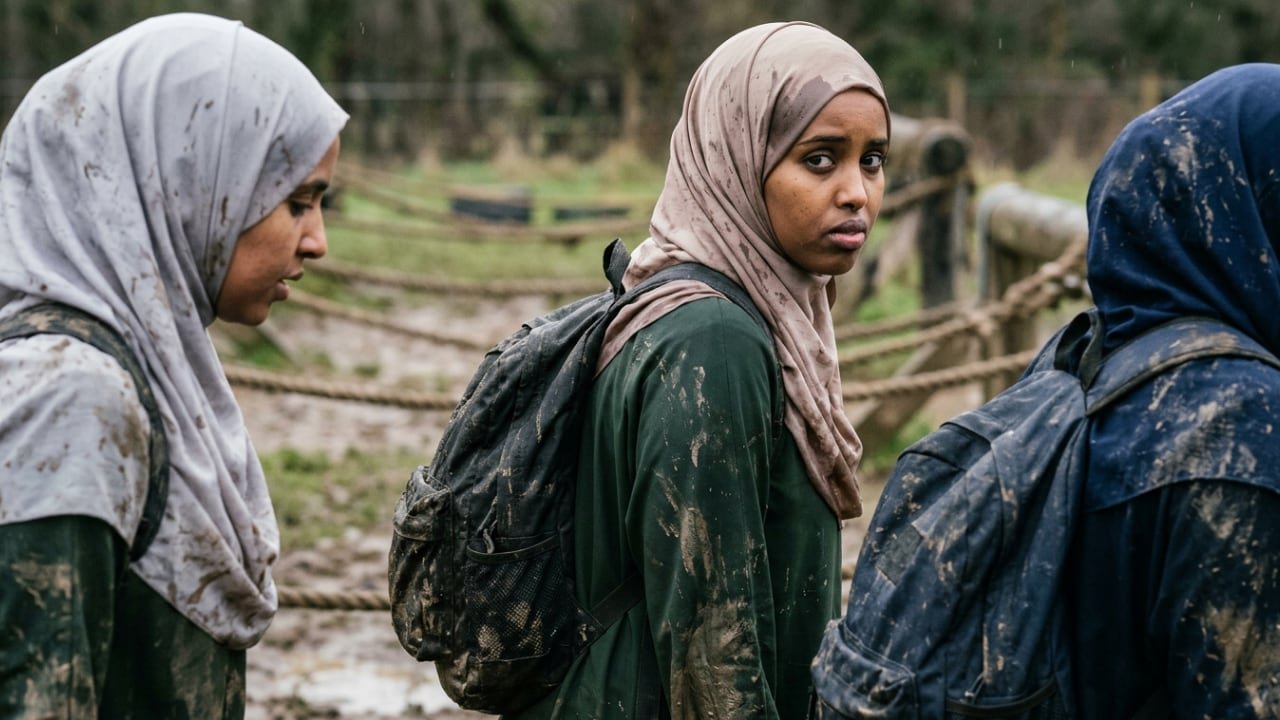
Refugee women do not choose the terrain they must cross. They walk through mud because the road is impassable, climb barriers because the border is closed, wade through water because the only route to safety runs through rivers or across seas. The ground beneath their feet offers no accommodation, makes no concession to modest dress or exhaustion or the weight of everything they carry. It simply is what it is — indifferent, demanding, unforgiving.
When you organise Trials & Tribulations, you seek ground that teaches this truth, that reminds comfortable sisters what displaced women already know: that sometimes the only path forward is the difficult one, that safety lies beyond obstacles that seem insurmountable, that persistence through terrain that resists you is not heroism but necessity.
Camelot Events at Henfold Lakes, set in Surrey countryside, offers such ground. Not because it replicates refugee experience, which would be impossible and presumptuous, but because it asks sisters to move through landscape that doesn’t accommodate them, that demands effort and persistence, that makes tangible what distant suffering too easily remains abstract.
The journey mirrors displacement
For sisters travelling by train from London Victoria, the experience begins before they reach the course. The hour’s journey carries them from urban familiarity into rural unfamiliarity, from streets they know into landscapes they must navigate without prior knowledge. This transition is deliberate: refugee women rarely flee within familiar territory. They move through countries whose languages they do not speak, whose landscapes offer no recognisable markers, whose very strangeness compounds the terror of displacement.
Alternatively, for groups travelling by minibus or car share, there is the longer trek from Inholms car park on the southern-most edge of Dorking, walking through Holmwood Common — National Trust woodland where paths wind through ancient trees and uneven ground tests balance and resolve. For the more ambitious, an even longer trek runs west to east across Leith Hill, Surrey’s highest point, where the ascent itself becomes teacher before the obstacles are even reached.
At Holmwood station, your participants step onto ground that doesn’t know them, into countryside that makes no allowance for their presence. The walk ahead — part of the Beare Green Circular Walk — becomes the first teacher of what it means to move through terrain that simply exists, indifferent to whether you are comfortable or prepared or confident of your direction.
Sisters walk through undulating farmland whilst fasting, their abayas catching on brambles, mud accumulating on shoes never designed for such walking. Each step away from the station is a step deeper into the kind of groundlessness refugees know intimately — not knowing exactly where you’re going, not certain when you’ll arrive, trusting that the path leads somewhere safe but having only faith and the footsteps of those ahead to guide you.
This isn’t mere logistics. This is embodied learning beginning before the obstacles are even reached, the body already teaching what the mind struggles to grasp: that displacement means moving through places that do not welcome you, that offer no familiar comfort, that demand you persist despite having no certainty about what lies ahead.
Ground that makes no concessions
The assault course itself — cargo nets, climbing walls, water crossings, muddy ditches — becomes vocabulary for speaking about what words often fail to convey. How do you help comfortable British Muslims understand what it means to carry everything you own whilst fleeing? The nets, climbed whilst carrying rucksacks, offer partial answer. How do you make tangible the barriers refugees face at borders? The climbing walls provide inadequate but honest approximation.
The mud speaks its own truth. Refugee women walk through mud not because they choose adventure but because the paved roads are blocked, because safety lies beyond terrain that resists every step. When your participants crawl through muddy ditches in their best abayas — clothing chosen for modesty and dignity now soaked and stained — they taste the smallest measure of what it means to move through ground that offers no accommodation, that takes rather than gives, that demands everything and returns only the permission to continue.
The team at Camelot Events understand they are facilitating something more serious than entertainment. They have hosted ladies-only events for Muslim communities before, have witnessed how obstacles become more than physical challenges when sisters undertake them whilst fasting, whilst maintaining modest dress, whilst carrying intention to walk with refugees rather than merely for personal achievement. Female instructors guide your groups when requested, creating space where sisters can struggle and persist without performing for male observation.
What this ground teaches
The landscape around Henfold Lakes offers lessons city environments cannot provide. Weather affects the challenge — rain makes mud deeper, wind cuts through wet abayas, cold penetrates exhausted bodies. This is important teaching. Refugee women cannot wait for good weather before fleeing. They walk in rain and cold and heat, their clothing inadequate for the climate they must traverse, their bodies pushed beyond comfortable limits not by choice but by circumstances that offer no alternative.
The ground itself resists. Heavy clay clings to feet, making each step heavier than the last. Inclines demand more energy than exhausted, fasting bodies believe they possess. Stiles and gates require navigation whilst carrying everything, require cooperation when individual strength proves insufficient. None of this is designed to be easy. All of it mirrors, however inadequately, what refugees face: terrain that doesn’t accommodate them, obstacles that must be overcome despite inadequate resources, distances that must be travelled despite exhaustion.
By the time your participants complete the course and reach the changing rooms, they will understand something they could not have grasped through description alone: that the body can endure more than the mind believes possible, that ground that seems insurmountable can be crossed when there is no alternative, that modest dress does not prevent persistence, that fasting does not eliminate capability.
The mercy of return
Showers and clean clothes await at the end. Transport stands ready to carry tired sisters home to safety and familiar comfort. This mercy — the guarantee of return, the certainty that difficulty is temporary — is precisely what refugees lack. They have no clean clothes waiting, no transport arranged, no certainty that the day’s exhaustion will be followed by night’s rest in secure shelter.
When your participants feel relief flooding through tired bodies as clean water washes away mud, when they change into dry clothing and know beds await them at home, let them hold this alongside what they have learned: that refugee women have no such certainty, that their exhaustion is not relieved by hot showers, that their displacement does not end when they want it to, that the difficulty you chose for one day is difficulty they cannot choose to end.
The changing rooms at Camelot Events are not reward for completion but opportunity for reflection — a space where comfortable certainty returns and makes visible, by its return, what it means when such certainty is lost and not recovered.
Why this ground serves your purpose
Camelot Events sits close enough to London that South East communities can reach it without prohibitive cost or time, yet far enough that arrival feels like genuine departure from the everyday. This balance matters. The venue’s accessibility removes the excuse of distance whilst providing genuine challenge.
The train journey becomes part of the pedagogy. Sisters watch London recede through windows, watch countryside emerge, feel themselves moving from known to unknown. This hour of travel is preparation time, transition time, the beginning of displacement however temporary and chosen. By the time they reach Holmwood and begin walking, they are already practising what refugees know: that safety lies beyond familiar territory, that reaching it requires moving through landscapes you do not know.
All the walking routes — whether the circular walk from Holmwood station, the woodland trek from Inholms car park, or the ambitious crossing of Leith Hill — culminate at the assault course. Each offers its own character of difficulty, its own teaching about persistence through terrain that resists. Together with the obstacles themselves, they create exactly what Trials & Tribulations needs: difficulty that teaches without overwhelming, challenge that builds empathy without pretending to replicate what cannot be replicated.
What you facilitate by choosing this ground
When you book Camelot Events for your challenge, understand what you set in motion. You are not organising team-building or fitness challenge dressed in charitable purpose. You are creating conditions where comfortable British Muslim women can glimpse, through their own tired bodies and muddy abayas, what displaced women endure not by choice but by desperate necessity.
The ground you choose becomes teacher: of how terrain resists, of how obstacles demand everything you have and then more, of how modest dress and fasting and exhaustion combine to make simple forward motion an act of will rather than ease. The journey to reach this ground becomes teacher of what it means to move from familiar to unfamiliar, to travel towards uncertainty. The return becomes teacher of what mercy it is to have certainty of return, to know comfort awaits, to experience difficulty as temporary rather than indefinite.
Your participants will not become refugees through this challenge. They will remain comfortable British women who chose difficulty and can choose to end it. But they might emerge slightly changed, with abstract empathy transformed into something their bodies remember, with comfortable distance between “us” and “them” reduced if not eliminated, with new understanding of what it costs to keep moving when ground and obstacles and exhaustion all argue for stopping.
For those who organise
Book this venue knowing you are not purchasing entertainment but facilitating transformation. The ground will do its work. The obstacles will teach. The mud will cling and the exhaustion will accumulate and the fasting will make everything harder. This is exactly what you want: difficulty that cannot be avoided, challenge that must be met, terrain that offers no easy passage.
Camelot Events understands this work and will help you create what your community needs. Discuss with them your specific requirements for ladies-only sessions, for female instructors, for the particular combination of challenge and safety that Trials & Tribulations demands. Explain that you are building solidarity with refugees, that the obstacles serve purposes beyond physical achievement.
The practical details matter: train times and parking, changing facilities and first aid, booking and payment. But do not let logistics obscure the profound opportunity you create by choosing this ground. You are offering sisters the chance to walk, however briefly and inadequately, in the footsteps of displaced women. You are giving them mud and obstacles and exhaustion as teachers of what distant suffering too easily remains abstract.
May the ground teach well. May the obstacles reveal what needs revealing. May the exhaustion and mud and persistent difficulty open hearts that comfortable certainty keeps closed. May your participants emerge changed — not dramatically, not perfectly, but genuinely — by having chosen to walk on ground that makes no concessions, that demands everything, that teaches through the body what the mind alone struggles to grasp.
Choose this ground for your challenge. Let it teach what it knows. Trust the obstacles and the mud and the exhaustion to do their work. And watch as sisters emerge changed by having walked, however briefly, on terrain that mirrors the ground refugee women must cross — ground that offers no accommodation, demands everything, and returns only the hard mercy of being allowed to continue.