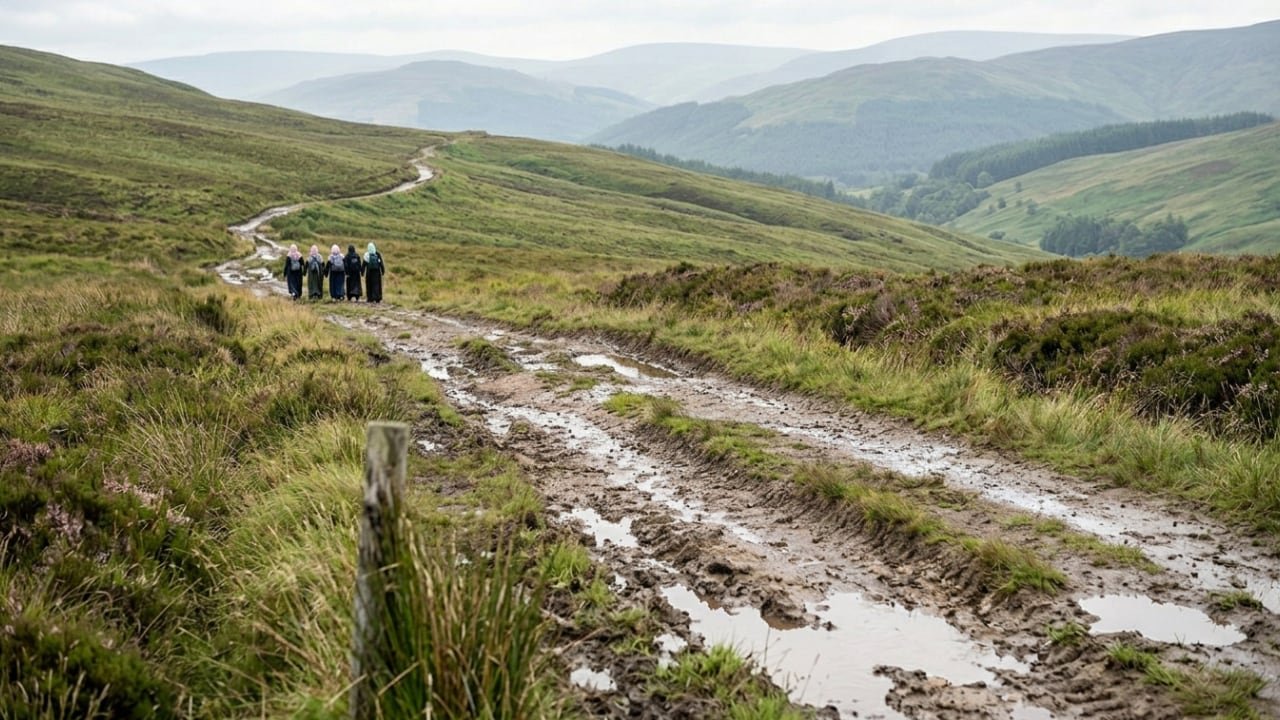
Not every community sits near an assault course. Not every organiser has access to professionally managed obstacles or facilities designed for physical challenge. But this need not prevent you from facilitating Trials & Tribulations. Britain’s landscape offers its own obstacles, its own difficulties, its own ground that teaches what refugee women already know: that sometimes the only path forward is the difficult one, that terrain offers no accommodation to those who must cross it, that persistence through mud and exhaustion and landscape that resists you is not heroism but necessity when stopping is not option.
Refugee women fleeing violence do not follow marked trails or navigate courses designed for safety. They walk through bogs that threaten to swallow them, cross moorland that offers no shelter, traverse ground that gives way beneath exhausted feet. When you create Trials & Tribulations using Britain’s natural muddy landscapes, you honour this reality more authentically than any constructed course could—not because natural mud is somehow more legitimate than course mud, but because the unpredictability, the lack of infrastructure, the sheer indifference of landscape mirrors more closely what displaced women face.
Choosing ground that teaches
Britain’s muddy landscapes speak different dialects of difficulty. Each offers distinct lessons, particular challenges, specific ways of understanding what it means to move through terrain that does not accommodate you. As organiser, your task is matching landscape to what you want your participants to learn, what particular aspect of refugee experience you want to illuminate through embodied struggle.
Moorland and peat bogs: uncertainty underfoot
Dartmoor’s sprawling peat bogs, Kinder Scout’s treacherous moorland, the Brecon Beacons’ boggy expanses. These places teach what it means to walk on ground that might betray you, that offers no certainty about what lies beneath the next step, that demands constant vigilance and adjustment. Fox Tor Mire, the inspiration for Conan Doyle’s Grimpen Mire, remains captivatingly uncertain — beautiful and threatening both, ground that must be respected because it will not accommodate carelessness.
When refugee women flee through unfamiliar terrain, they cannot know which ground will hold and which will give way. They step forward trusting their feet will find purchase, adjusting when ground proves unreliable, persisting because turning back means danger greater than what lies ahead. Your participants walking across moorland whilst fasting, their abayas heavy with accumulated moisture, will learn this uncertainty in their own careful stepping, their own moments of ground shifting beneath them, their own persistent forward motion despite not knowing whether the next step will hold.
Pedagogical use: Choose moorland when you want to teach about uncertainty, about moving through landscape you cannot predict, about trusting the next step when you cannot see the ground beyond it. Walk these places in late autumn through early spring when rain has saturated the peat, when every step demands attention, when the bog teaches that refugees navigate not just distance but persistent uncertainty about whether the ground itself will permit passage.
Coastal mudflats: the weight of time and tide
The Solway Firth mudflats, Norfolk’s salt marshes, the tidal expanses along Wales’s coastline. These places teach what it means to move through landscape governed by forces beyond human control, where timing determines survival, where ground that seems passable becomes trap when tides shift. The mud here is particular — sticky, clinging, exhausting — the kind that makes each step cost more than the last, that accumulates on shoes until simple walking becomes labour.
Refugee women fleeing toward coastlines face this reality: ground that permits passage only at certain times, water that might allow crossing or might rise too quickly, landscape where hesitation or poor timing means being caught between safety and return, neither reachable. When your participants walk coastal mudflats whilst fasting, feeling exhaustion accumulate with the mud, they taste something of what it means to move through terrain that demands everything whilst offering no certainty.
Pedagogical use: Choose coastal routes when you want to teach about barriers and crossings, about water representing both hope and danger, about timing and tide governing possibility. Walk these places during low tide, when mudflats are exposed but the knowledge of returning water adds urgency, when the sea visible beyond teaches that refugees flee toward water they must somehow cross despite having no guarantee passage will be possible or safe.
Ancient woodland: persistence through resistance
Epping Forest’s seasonal ponds, Sherwood’s muddy hollows, the New Forest’s boggy stretches, Grizedale’s saturated paths. These places teach what it means to navigate terrain that actively resists, that requires negotiating roots and mud and water, that offers no clear passage but only obstacles to be worked through individually and together. The mud in ancient woodland is different from moorland bog or coastal silt — heavy clay that clings, that makes feet heavy, that turns simple walking into sustained effort.
Refugee women moving through forested areas face this resistance — ground that does not want to let them pass, terrain that demands constant negotiation, landscape that exhausts through persistent small difficulties rather than single overwhelming obstacle. When your participants navigate woodland trails whilst fasting, their abayas catching on branches, their feet heavy with accumulated mud, they learn what sustained difficulty teaches: that sometimes the challenge is not dramatic crisis but hour after hour of ground that resists, that makes you work for every metre gained.
Pedagogical use: Choose ancient woodland when you want to teach about sustained difficulty, about terrain that resists rather than permits, about the exhaustion that comes not from single obstacle but from accumulated small struggles. Walk these places in early spring when seasonal ponds form in hollows, when the ground is saturated from winter rain, when the woodland teaches that forward motion sometimes means working through resistance rather than flowing around it.
Common land and open moor: exposure and vastness
The Yorkshire Dales, Ashridge Estate’s boundary trail, the South Downs Way, Tegg’s Nose Country Park. These places teach what it means to be exposed, to move through landscape that offers no shelter, to feel small against vastness that cares nothing for your presence. The paths across common land are often muddy not dramatically but persistently, the kind of everyday difficulty that accumulates, that wears down through duration rather than intensity.
Refugee women crossing open country face this exposure — no shelter from weather, no hiding from those who might threaten them, no respite from the watching sky and the ground that stretches endlessly toward horizons they can only hope lead to safety. When your participants walk across common land whilst fasting, feeling wind cut through wet abayas, seeing the path stretch ahead with no clear end, they glimpse what it means to be vulnerable and exposed, to persist through landscape that offers no comfort or concealment.
Pedagogical use: Choose common land when you want to teach about exposure and vulnerability, about moving through open spaces that offer no shelter, about the particular exhaustion of walking toward horizons that never seem closer. Walk these places when weather threatens, when wind makes everything harder, when the openness itself becomes teacher of what it means to have nowhere to hide, nothing to shelter behind, only the next step and the determination to take it.
Designing your natural challenge
Unlike professionally managed assault courses, natural landscapes require careful planning around factors you cannot control — weather, seasonal conditions, accessibility, safety considerations that change with terrain. Your task as organiser is creating challenge that teaches without overwhelming, difficulty that builds empathy without creating genuine danger.
The walking trek as foundation
Every natural Trials & Tribulations should begin with sustained walking. Not brief stroll but hours of movement, enough to build genuine fatigue, to make fasting felt in tired legs, to create the accumulated exhaustion that teaches what refugees face over days and weeks. The walk itself becomes primary teacher, with natural obstacles encountered along the way adding specific lessons.
Distance considerations:
- Minimum four miles for participants to feel genuine fatigue
- Six to eight miles creates substantial challenge whilst remaining achievable
- Plan for slower pace than normal walking: mud, obstacles, fasting all reduce speed
- Include varied terrain: flat stretches for building distance, inclines for testing endurance, muddy sections for teaching persistence through resistance
Route selection:
- Choose circular routes when possible so arrival point matches departure
- Plan paths that transition through different landscapes: woodland to open moor, gentle to challenging terrain
- Identify natural rest points where groups can pause without compromising challenge
- Verify paths are legally accessible and appropriate for your group size
Natural obstacles as specific teaching
Britain’s muddy landscapes offer obstacles that teach without requiring construction: streams to wade, slopes to climb, bogs to navigate, gates and stiles whilst carrying rucksacks. Your task is identifying these natural challenges and framing them for participants so they understand what each obstacle represents about refugee experiences.
Water crossings: Streams, seasonal ponds, flooded paths. These teach about barriers that must be crossed despite cold, despite wet clothing compromising warmth and dignity, despite exhaustion arguing for avoiding difficulty. Frame these as Mediterranean crossings, river borders, the water obstacles that refugee women face knowing getting wet might mean hypothermia, knowing soaked clothing will make everything harder, knowing passage is necessary regardless.
Muddy sections: Bogs, clay paths, saturated ground. These teach about terrain that resists, that makes each step cost more than expected, that exhausts through persistent difficulty rather than single challenge. Frame these as the unpaved paths refugees walk, the terrain they cross because roads are blocked or dangerous, the ground that offers no accommodation to those who must traverse it.
Inclines and descents: Hills, moorland slopes, woodland banks. These test exhausted bodies, demand strength participants did not know they needed to conserve, require mutual support when individual capability proves insufficient. Frame these as the mountain crossings refugees face, the terrain they must navigate despite altitude and exhaustion conspiring against them.
Natural barriers: Stiles, gates, fallen trees, rocky sections. These require negotiation whilst carrying everything, demand cooperation when obstacles cannot be overcome individually. Frame these as the checkpoints and barriers refugees face, the obstacles designed to prevent passage that must be overcome anyway because safety lies beyond and stopping is not option.
Managing what you cannot control
Natural landscapes teach partly because they remain indifferent to human preference, but this indifference creates safety considerations you must address. Refugee women face genuine danger from terrain; your participants should face genuine difficulty without genuine risk.
Weather monitoring: Check forecasts repeatedly in days before the challenge. Heavy rain might make bogs dangerous, might flood paths beyond safe passage. Be prepared to postpone if conditions create genuine rather than productive risk. The disappointment of postponement is better than the crisis of participants in actual danger.
Emergency protocols: Unlike assault courses with professional supervision, natural landscapes may be remote from immediate help. Carry comprehensive first aid supplies. Ensure mobile phone coverage or carry emergency communication. Know exact location coordinates for every section of your route. Have clear plan for extracting participant who cannot continue or who suffers injury.
Group management: Natural obstacles are less predictable than constructed ones. Maintain close group cohesion: no one left far behind, no one permitted to push far ahead. Designate experienced walkers as leaders and sweepers. Build in frequent count-offs to ensure no one is lost.
Participant preparation: Be explicit about difficulty level. Require waterproof footwear and layers appropriate for weather. Insist on rucksacks with waterproofed change of clothes. Do not permit participants to undertake natural challenge without adequate preparation as the landscape will not accommodate poor planning.
Specific routes for consideration
These suggestions offer starting points for different regions, different difficulty levels, different pedagogical focuses. Adapt them to your community’s location, capabilities, and what you want participants to learn.
For southern communities: Seven Sisters and coastal exposure
- Route: Seven Sisters Country Park coastal path, six miles, exposed clifftop walking with muddy inland sections
- Teaching focus: Barriers and crossings, exposure and vulnerability, beauty and danger intertwined
- Timing: Autumn through spring for muddy conditions
- Considerations: Wind exposure significant, clifftop paths require caution, stunning views offer moments for reflection on both beauty of creation and dangers refugees face crossing water
For northern communities: Yorkshire Dales and open persistence
- Route: Malham circular walk incorporating Malham Tarn and surrounding moorland, eight miles, varied terrain
- Teaching focus: Sustained difficulty through accumulated obstacles, wetland navigation, limestone landscape teaching about ground that shifts between solid and treacherous
- Timing: Late autumn through early spring for maximum mud
- Considerations: Significant elevation changes, moorland sections can be boggy and uncertain, rich in geological and ecological interest for deeper reflection
For Midlands communities: Peak District moorland challenge
- Route: Kinder Scout circuit via boggy moorland, six miles, peat bog navigation
- Teaching focus: Uncertainty underfoot, exposed moorland walking, famous location adding historical weight to contemporary challenge
- Timing: Spring or autumn for manageable conditions with sufficient mud
- Considerations: Peat bogs require careful navigation, weather changes rapidly on exposed moor, iconic Peak District landscape offers powerful backdrop for reflection
For Welsh communities: Brecon Beacons waterfall trail
- Route: Four Waterfalls Walk incorporating muddy woodland paths and stream crossings, five miles circular
- Teaching focus: Water obstacles, woodland resistance, beauty amidst difficulty
- Timing: Autumn through spring for full water flow and muddy paths
- Considerations: Multiple stream crossings teach about water barriers, woodland paths become very muddy, waterfalls offer natural rest points for reflection and prayer
For East Anglian communities: Norfolk coastal marshes
- Route: Blakeney Point circular incorporating salt marshes and coastal mudflats, six miles
- Teaching focus: Tidal timing and urgency, distinctive marsh mud teaching about ground that clings and exhausts, wildlife richness showing what flourishes in difficult terrain
- Timing: Plan around low tide, autumn through spring for muddy conditions
- Considerations: Must coordinate with tides, marsh mud is particularly clinging and exhausting, seal colonies visible from distance offer wildlife perspective
What you facilitate through natural challenge
When you create Trials & Tribulations using Britain’s muddy landscapes rather than constructed assault courses, you offer something distinct: challenge that comes not from human design but from the landscape itself, difficulty that exists not for training purposes but simply because the ground is what it is, obstacles that were not placed for your benefit but must be navigated because they cannot be avoided.
This authenticity serves your pedagogical purpose. Refugee women do not face obstacles designed to be achievable or arranged for progressive difficulty. They face landscape that simply exists, terrain that must be crossed whether it accommodates them or not, ground that offers no concession to their exhaustion or their modest dress or the weight of everything they carry. Natural challenge honours this reality more honestly than any constructed course, however well designed.
Your participants walking across moorland, navigating woodland, traversing coastal paths whilst fasting will learn what the landscape teaches: that forward motion through difficult terrain requires more than determination. It requires adaptability when ground proves different than expected, cooperation when obstacles exceed individual capability, persistent effort when no single dramatic push will suffice but only hour after hour of placing one foot before the other despite mud and exhaustion and the body’s protests.
For those who organise without courses
Do not see the absence of assault courses as limitation. See instead the opportunity to use Britain’s extraordinary muddy landscapes as teachers, to let natural obstacles create challenges that honour refugee experiences precisely because they were not designed to be overcome, were not constructed to be achievable, were not placed for your benefit but simply exist as part of the landscape refugee women must navigate.
Choose your ground carefully. Design your route thoughtfully. Prepare your participants thoroughly. Manage safety seriously. But trust the landscape to teach what it knows: about difficulty that cannot be avoided only worked through, about terrain that does not accommodate only demands adaptation, about the persistent effort required when the path forward offers no ease only the necessity of continuing because stopping is not option.
May the moorland teach uncertainty. May the coastal mud teach about barriers and crossings. May the ancient woodlands teach sustained resistance. May the open commons teach exposure and vulnerability. May your participants emerge changed by having walked ground that made no concessions, that demanded everything, that taught through indifference rather than design what refugee women already know: that sometimes the only path to safety runs through terrain that offers no welcome, only the possibility of passage for those determined enough to persist.
This is the gift of natural challenge. This is why Britain’s muddy landscapes serve Trials & Tribulations when assault courses are not accessible. Not because they are easier to organise — if anything, they demand more planning, more local knowledge and more acceptance of uncertainty — but because the ground itself becomes teacher, because the obstacles were not placed for you but simply exist, because the difficulty honours refugee reality through authenticity rather than simulation.
Choose this ground well. Let it teach. Trust the mud and the exhaustion and the persistent difficulty to do their transformative work. And watch as sisters emerge understanding differently what they thought they knew, carrying in tired muscles and muddy abayas the embodied knowledge that comfortable distance could never provide.