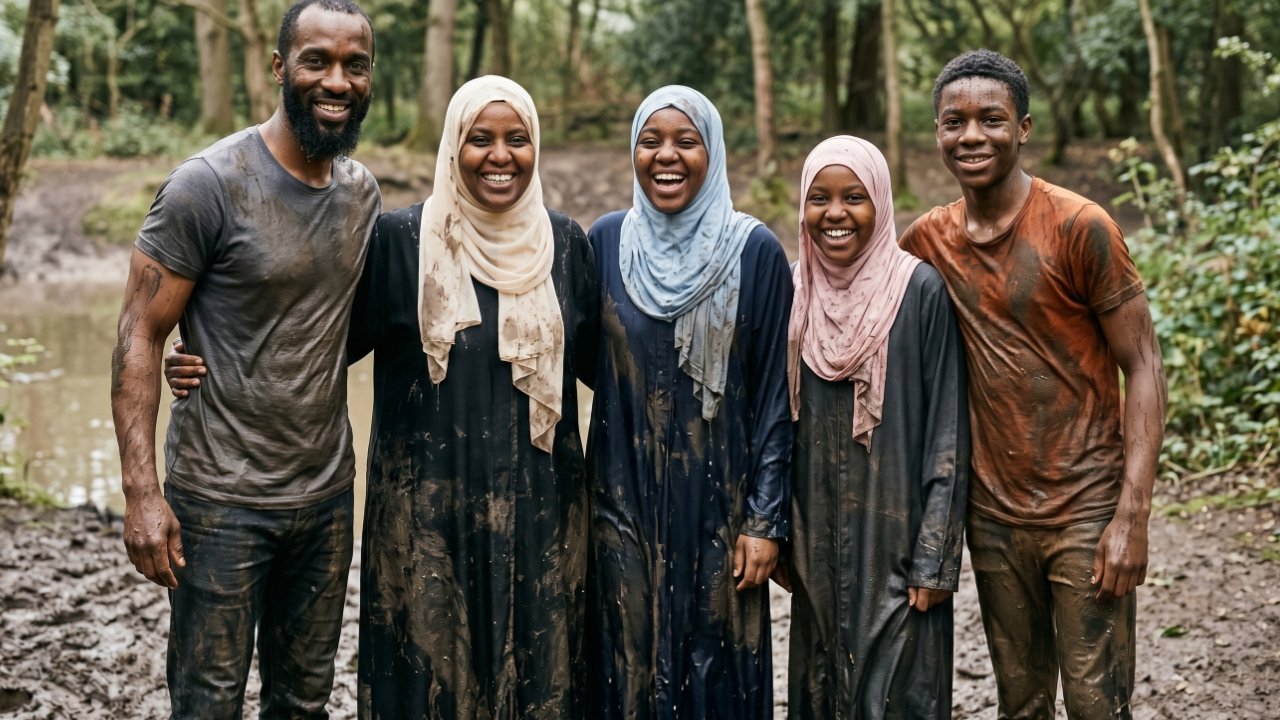
Picture this: your daughter staring wide-eyed as you, her mum, who she’s only ever seen in the kitchen or at school pickup or reminding everyone about homework, stand at the bottom of a cargo net in your best abaya, mud already splattered up to your knees, determination written across your face as you reach for the first handhold. She’s seen you cook and clean and manage household logistics with ruthless efficiency. She’s never seen you do this.
“Mum, are you actually going to climb that?”
You are. You’re going to climb it whilst fasting, whilst wearing an abaya that definitely wasn’t designed for assault courses, whilst your younger son shouts encouragement and your husband waits at the top ready to help pull you over.
You’re going to struggle halfway up, pause to catch your breath, and keep going despite every comfortable instinct suggesting this is ridiculous. And your children are going to watch their mother become someone slightly different: not weaker for struggling but stronger for persisting, not diminished by difficulty but enlarged by refusing to let it defeat her.
This is Trials & Tribulations as a family. This is what happens when you choose to get spectacularly muddy together, facing obstacles as a unit, and when children discover their parents are human beings capable of attempting genuinely hard things for purposes beyond comfortable routine.
The moment everything shifts
There’s a precise instant when it stops being “Mum’s weird idea” and becomes “the thing we’re doing together,” and often it happens in the first puddle of proper mud, of the kind that sucks at shoes and splatters higher than anyone expected.
Your teenagers were rolling their eyes twenty minutes ago. Now your daughter is laughing as mud covers her abaya, your son is helping his younger sister navigate the deepest section, and everyone has forgotten to be cool and distant because you’re all equally ridiculous-looking and it’s somehow hilarious.
The mud is the great equaliser. Dad’s careful attempt to stay relatively clean fails spectacularly at the first obstacle. Mum’s favourite abaya, worn as statement of dignity and commitment, acquires mud stains that will never fully wash out. The children who thought they’d stay ahead discover that wet, muddy modest dress slows everyone down, that this isn’t about being fastest but about moving together.
And somewhere in the shared ridiculousness of being covered head to toe in mud, whilst fasting and attempting obstacles that seem designed to make you filthier, you stop being just parents-and-children doing an activity and become a team discovering what you’re capable of when comfortable certainty gives way to muddy uncertainty.
What children see that changes everything
Your daughter has seen you pray, watched you fast during Ramadan, heard you talk about refugee responsibility and ummah obligations. She knows you believe these things. But she’s never seen you embody them quite like this: choosing genuine difficulty because solidarity costs something, persisting through discomfort that could easily be avoided, demonstrating through your mud-covered, exhausted, stubbornly determined presence that faith requires more than words.
When you crawl under obstacles and your abaya drags through mud, when you wade through cold water and modest dress becomes heavy and clinging, when you scale walls whilst maintaining hijab and refusing to quit despite being forty-something and tired, she sees Islam differently — not as rules that constrain but as commitment that empowers, not as inherited identity but as lived faith chosen daily, even when choosing costs comfort.
She also sees you differently. You’re not just Mum-who-makes-dinner-and-nags-about-homework but a woman who attempts difficult things, who struggles visibly and persists anyway, who gets just as muddy as everyone else and laughs about it. This knowledge settles somewhere deep, reshaping how she understands what Muslim women can be, what mothers contain beyond domestic competence, and what faith looks like when embodied rather than merely discussed.
Meanwhile your son watches his father help you over a wall you can’t quite manage alone, not patronising assistance but genuine partnership: Dad bracing himself so Mum can use his shoulder, Mum trusting Dad’s stability, both working together because the obstacle exceeds individual capability. He’s learning something no lecture about marriage could teach — what partnership looks like under pressure, what cooperation means when difficulty is real, what it means to be a team rather than merely sharing a household.
The teenage daughter who rolls her eyes at demonstrations of parental affection watches her parents work as a unit and sees something similar: not romantic performance but practical cooperation, not just compatibility but complementary strengths deployed together when the way forward genuinely requires both of them.
The profound hidden in the playful
Yes, this is fun. The mud fights that break out despite everyone being exhausted, the laughter when someone slips and goes down in spectacular fashion, the shared triumph when you all make it over an obstacle that seemed impossible five minutes ago, the photos afterward where everyone looks equally bedraggled and somehow radiant with accomplishment.
There’s particular delight in doing something slightly absurd together, in being British Muslims choosing to spend Saturday getting filthy whilst fasting, attempting obstacles in modest dress that makes everything harder. It’s unconventional. It’s probably slightly mad. But it’s also glorious — and the joy doesn’t diminish the purpose.
If anything, it deepens it, because refugee women who persist through impossible journeys don’t do so grimly. They also laugh when they can, find moments of lightness amidst darkness, discover that joy survives even in difficulty. When your family laughs whilst muddy and exhausted, you honour something essential about human resilience: that we can face hard things without becoming hard ourselves.
Underneath the fun, though, runs something deeper. You’re walking for women who navigate impossible terrain not by choice but by necessity, who maintain modest dress whilst fleeing violence, who persist through exhaustion because stopping means danger. When your family chooses difficulty together, when you feel the weight of a wet abaya or the exhaustion of fasting through physical challenge, when you discover that the ground offers no accommodation and obstacles don’t adjust to your preferences, you taste the smallest edge of what displacement costs.
Your children are focused on the mud and the obstacles and whether they can beat their sibling through the next challenge, but the experience settles anyway, creating foundation for future understanding, planting seeds that will grow when they encounter refugee stories in years to come.
You don’t need to labour the connection at every moment — a few words during the challenge are enough: “Imagine if you had to do this for days, not hours.” “Think about crossing rivers when they’re the only route to safety.” Brief acknowledgements of why you’re here and who you’re walking with in spirit if not in fact.
What you’re building beyond today
The mud will wash off and the bruises will fade, but what remains, what becomes part of your family’s story and what your children will carry into adulthood, is the memory of choosing difficulty together. They’ll remember the day Mum climbed the cargo net in her abaya, the moment Dad went down in the mud and came up laughing, the obstacle that seemed impossible until the family tackled it as one.
These memories become foundation for understanding that your family doesn’t just talk about faith but practises it, that solidarity costs something and you’re willing to pay it, that Muslim women can be modest and capable simultaneously, that marriage involves partnership through genuine difficulty rather than merely shared logistics.
You’re the one who’ll organise this, convincing reluctant teenagers, managing the logistics, ensuring everyone has appropriate clothing, carrying the mental load of making it happen whilst also participating fully yourself. And you’ll be the one they remember most vividly, not because you were strongest or fastest but because they saw you in a completely new context: out of the kitchen and away from everything familiar, attempting something genuinely difficult, struggling visibly and persisting anyway.
Your daughter is watching how Muslim women navigate the world, whether faith constrains or empowers, what’s possible within modest dress and Islamic commitment. Your son is learning what women are capable of, what mothers contain beyond domestic competence.
When you emerge from that assault course, muddy beyond recognition and somehow radiant with accomplishment, you give your children something no lecture could provide: visible proof that their mother practises what she preaches, that faith requires embodiment, that choosing difficulty for purposes beyond yourself is not an abstract virtue but something your family actually does.
The invitation before you
One weekend. One assault course. One family choosing to get spectacularly muddy together whilst fasting, whilst maintaining modest dress, whilst walking in solidarity with refugees who face difficulties you can only briefly taste. It will be hard, someone will complain, the mud will ruin clothing, and you’ll spend the evening treating bruises and discussing whether it was worth it.
But the laughter shared in ridiculous circumstances, the children seeing their parents in new light, the embodied understanding of what solidarity costs, the discovery of what your family is capable of when comfort gives way to chosen difficulty: all of this will outlast the exhaustion, settle into memory, and become part of who your family understands itself to be. The obstacles stand ready. Will you climb them together?