You know the rhythm well by now: the crafting of appeals, the careful construction of emails, the multiplication of social media posts. Hours fold into weeks as you reach outward to your supporter base, searching for participants willing to undertake your sponsored challenges. Sometimes the response swells like answered prayer. Sometimes silence answers instead, despite all you’ve invested.
Yet perhaps you’ve been looking past the most natural participants: those already woven into your organisational fabric and committed to refugee support, showing up daily to serve this cause. Your staff and volunteers carry something your scattered supporters cannot: proximity to the work, investment in the mission, understanding of why refugee support demands more than distant compassion.
What if they should be the ones to undertake Trials & Tribulations first?
This isn’t merely pragmatic thinking about recruitment efficiency, though that matters. This is recognition that the challenge offers something your teams desperately need but rarely receive: embodied understanding of the displacement they work to address, renewed purpose forged not in meetings but through shared ordeal, and cohesion built through struggle rather than professional courtesy.
Some charities have already discovered this truth, not through careful planning but through bold experimentation. What they learned reshapes how we might think about where Trials & Tribulations belongs.
When participation becomes the work itself
The decision seems audacious when first announced: the challenge will be compulsory for all female staff. Not suggested with gentle encouragement, nor framed as optional team building, but compulsory. From senior leadership to newly hired administrators, from fundraising coordinators to marketing desks, the requirement spans every role. Ages range from early twenties to mid-fifties. Experience levels scatter across every spectrum. Fitness is not assessed. Enthusiasm is not required.
The grumbling begins immediately, as you might expect. “I’m too old for this.” “I didn’t sign up for physical challenges when I took this job.” “I’m going to call my union.” Resistance rises from predictable quarters: those who prefer comfortable distance from the difficult realities their charity addresses, those who see their work as purely professional rather than personally demanding, those who believe supporting refugees requires only competence at desks rather than embodied solidarity.
But the charity holds firm and structures it thoughtfully. Staff work their normal day, then roll seamlessly into an extra evening shift. Those whose roles don’t normally involve donor contact now cover the evening telecalling, reaching out to supporters whilst more experienced colleagues guide them. Junior sisters teach senior staff the ropes, showing them how to connect with supporters, handle objections, communicate the charity’s mission from unfamiliar territory.
When the work shift finally ends, evening merges into the gathering aspect of Trials & Tribulations. But the surroundings remain their own charity offices rather than unfamiliar venue. Their clothes stay what they wore for work: no special athletic gear nor careful preparation, just the abayas and hijabs they arrived in that morning. The meal isn’t something they’ve thoughtfully packed but takeaway bought in by management: pizza and burgers, humble fare shared whilst still in work mode, still sitting where they normally process donation data or draft appeals.
Then evening proceeds through its sacred rhythm: the inspiring talk that reorients hearts toward refugee experience, sisterhood forged through gathering with shared purpose, prayer together as colleagues become community, tahajjud in the deep quiet whilst the city sleeps beyond their office windows, attempting sleep on the hard floor where they normally sit at desks, rising early for suhoor, making intention to fast, Fajr prayer as dawn touches familiar surroundings with unfamiliar meaning.
By the time they set off early for the challenge itself, something has shifted. Any grudging annoyance about compulsory participation has dissolved into feeling of shared experience, of being all-in-it-together regardless of role or seniority or initial enthusiasm. The offices they’ve left behind still hold their desks and computers and the comfortable rhythms of professional work. But the women who depart are no longer quite the same people who arrived for work the previous morning.
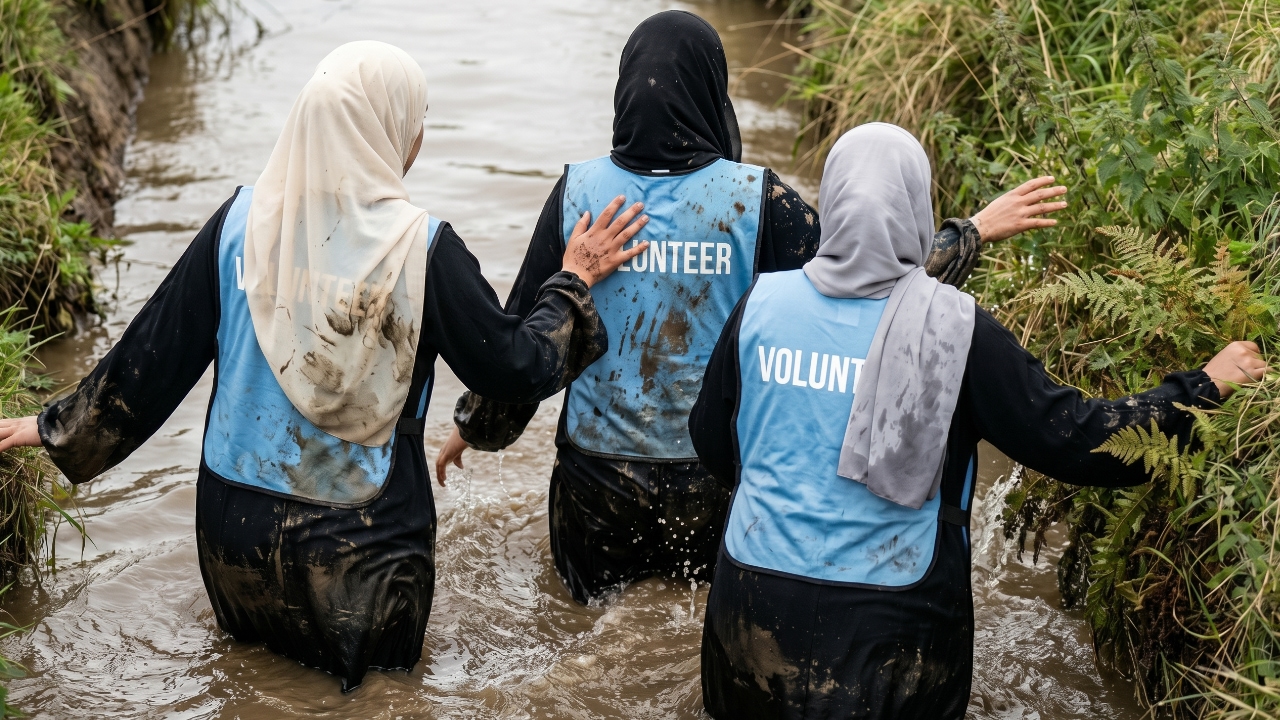
The challenge itself — the mud and cold water, the obstacles and exhaustion, all encountered whilst fasting — completes the transformation. They help each other over walls, pull colleagues from ditches, refuse to let anyone quit or fall behind. Hierarchies flatten under the weight of shared struggle. The competencies that matter at desks become irrelevant here; what counts now is persistence, mutual support, willingness to continue when every comfortable instinct suggests surrender.
They break fast at Iftar still in their muddied office clothes, utterly transformed from the professionals who began work the previous morning. They return to offices that look the same but will never quite feel the same, because now they carry in their tired bodies understanding of what the refugees they serve actually endure, why their work matters beyond professional competence, what solidarity requires when stripped of comfortable distance.
When volunteers discover why they volunteered
The second charity takes different approach, weaving Trials & Tribulations into what would normally be volunteer training and team building, transforming dry necessity into embodied education.
Morning proceeds conventionally enough: training activities covering typical aspects of charity volunteering: ethics, safeguarding, education on the cause, initial team building exercises. The volunteers, many fresh from universities, most quite young, all earnest about supporting refugees, absorb information in familiar format. Presentations, discussions, the comfortable teaching methods everyone recognises.
Then afternoon shifts everything. The trek — what Trials & Tribulations calls “Take Flight” — and the “Serious Trials” assault course, all undertaken in the clothes they arrived in that morning. Abayas and hijabs, modest dress designed for comfortable volunteering rather than physical challenge, now tested by mud, water and obstacles that demand more than they anticipated when dressing for what they thought would be conventional training.
This is team building unlike anything conventional training provides. Abstract concepts about supporting refugees become visceral reality as they struggle through difficulties that echo, however inadequately, what displaced people endure. Ethics discussions about dignity and respect gain new dimension when they’re helping each other maintain modesty whilst climbing walls. Safeguarding principles about protecting the vulnerable resonate differently when they’re experiencing their own vulnerability, discovering how much they need each other’s support to persist.
The challenge proves seriously trying at times. The name “Serious Trials” earns its weight as exhaustion sets in, as modest dress complicates every obstacle, as the gap between their comfortable lives and refugee realities becomes palpable rather than merely intellectual. But it’s also, unexpectedly, joyful: the kind of joy that emerges through shared ordeal, through discovering collective strength, through laughing at absurdity whilst covered in mud and still going.
They emerge with a buzz that conventional training never creates, with renewed sense of commitment to the charity they’ve volunteered for. More than that: they emerge with understanding of why their volunteer work matters, what refugees actually face, why the cause deserves their sustained engagement rather than casual involvement. The training has informed their minds; the challenge has taught their bodies and hearts.
What you gain
Both charities discover benefits extending far beyond the funds raised, though that financial aspect proves significant. Supporters who sponsor staff or volunteers can see what participation costs, witness the transformation, recognise that this isn’t merely symbolic gesture but genuine struggle undertaken in solidarity with refugees.
But the other gains prove equally valuable, perhaps more so. Teams become genuinely cohesive in ways that office interactions and conventional team building never achieve. Working together to overcome obstacles whilst fasting and exhausted creates bonds that translate back to professional context: better collaboration, deeper trust, willingness to support each other through workplace difficulties because they’ve already practiced supporting each other through much harder challenges.
Hidden strengths surface that would have remained hidden in professional contexts. The quiet administrator who proves remarkably resilient under physical stress. The senior manager who struggles more than expected but refuses to quit, demonstrating persistence that inspires others. The young volunteer whose encouragement keeps older participants moving when they want to stop. These discoveries reshape how teams see each other, revealing capacities that professional work rarely tests.
For staff for whom participation has been made compulsory, that lack of choice generates profound empathy for refugees who must flee without choice. Those who think “I’m too old for this” recall that catastrophe does not discriminate by age: displacement happens to the elderly as surely as to the young. Those who initially resist find their reluctance itself becomes teaching. If they struggle with one day of chosen difficulty, how much more do refugees struggle with years of unchosen displacement?
The photos, videos and testimonials generated by staff and volunteers undertaking the challenge prove invaluable for future recruitment from wider supporter base. Potential participants can see that this isn’t reserved for the especially athletic or particularly young, that ordinary women in professional roles complete it whilst maintaining modesty, that the transformation is real rather than merely claimed.
Beyond these deeper benefits, practical advantages are substantial. No lengthy recruitment campaigns required for you already have access to these participants, who are already committed to your cause, familiar with your organisation, invested in refugee support. Built-in understanding of your charity’s mission means staff and volunteers need no extensive briefing.
Natural ambassadors for future events emerge once your teams have completed the challenge, their testimonials carrying weight that external marketing never achieves. Flexibility in scheduling becomes possible when working with your own teams: integrating the challenge into training days for volunteers, making it part of professional development for staff, structuring it around work schedules rather than external participants’ availability.
Making it work
If you find yourself persuaded that starting with your own teams makes sense, here are principles these two charities discovered:
Be bold about expectations. The first charity makes it compulsory and, despite initial resistance, this proves profoundly meaningful. When participation is optional, those who most need the transformation often self-select out. When it’s expected — presented not as punishment but as essential part of working for refugee-focused charity — it becomes opportunity for everyone to deepen their commitment.
Integrate it into existing structures. Whether merging it with volunteer training or extending work responsibilities, find ways to make the challenge feel like natural extension of roles rather than completely separate activity.
Don’t over-prepare or over-accommodate. Both charities succeed partly by not making special provisions. Regular clothes, office floors, humble meals: these reinforce that the challenge is about solidarity rather than comfort, that refugees don’t get to prepare carefully or ensure ideal conditions.
Let resistance be part of the pedagogy. Those who resist, who think they’re too old, who question why this should be required find their reluctance itself connects them to refugee experience. Refugees don’t want to flee either. No one enthusiastically embraces displacement.
Document authentically. Capture the transformation through photos and testimonials, but do so honestly rather than staging perfect moments. The muddied clothes, the exhaustion, the struggle: these are what make the content powerful. Let the difficulty show.
Consider making it regular fixture. The second charity decides on biennial schedule for volunteer cohorts. When the challenge becomes expected part of organisational culture rather than one-off event, it shapes how people understand what working or volunteering for your charity entails.
An invitation
You already have the participants you need. They show up daily to serve your mission. They’ve already committed to supporting refugees. What they may lack is embodied understanding, connection to refugee experience forged through chosen difficulty rather than comfortable distance.
Trials & Tribulations offers precisely this. Not as addition to your fundraising strategy but as transformation of your organisational culture. Not as external event requiring extensive recruitment but as internal formation that deepens every aspect of your charity’s work.
Your staff need this: to remember why their work matters beyond professional competence, to embody the solidarity their daily tasks serve, to discover strengths that desk work never reveals. Your volunteers need it too: to truly understand what they’re volunteering for, to forge bonds through shared struggle that make their ongoing commitment more meaningful.
But perhaps more than anything else, your charity needs teams more cohesive, purpose more tangible, commitment more deeply rooted, born of walking in the shoes of those you serve.