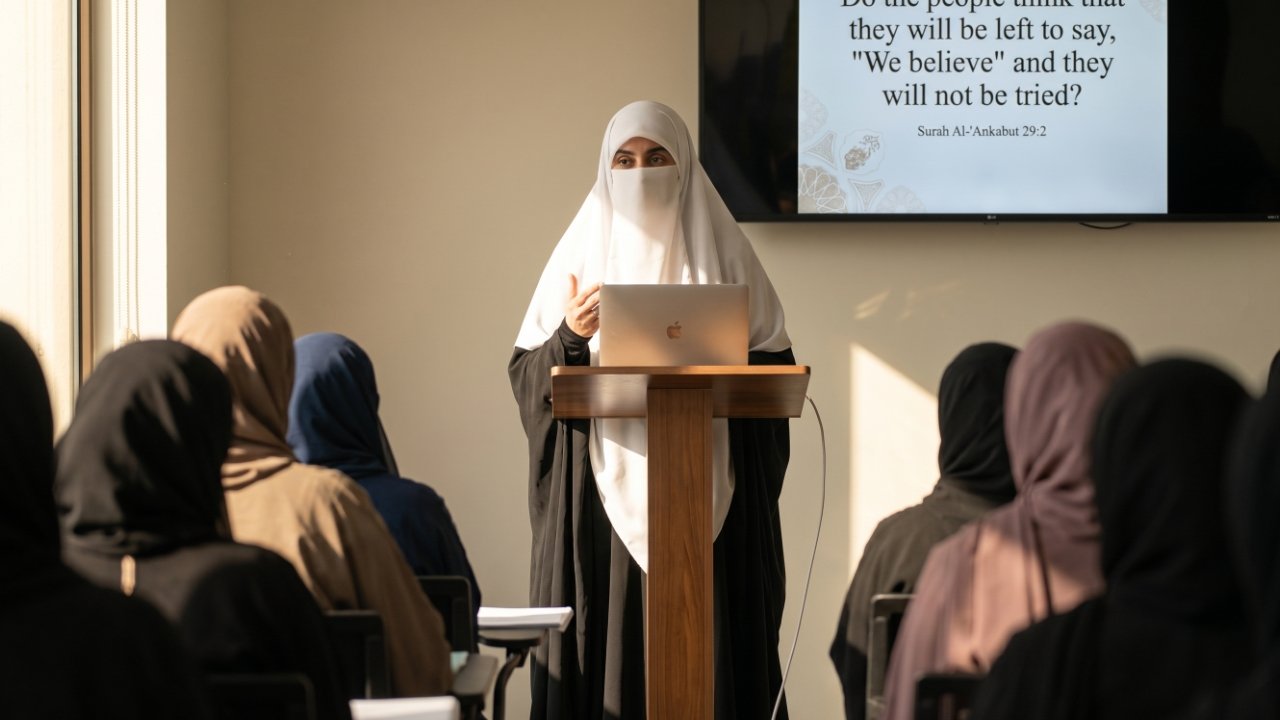
There exists within your community women whose voices already carry weight — the alimas who unpack sacred texts with patient hands, the madrasah teachers who plant seeds of faith in young hearts, the activists whose conviction moves mountains, the da’wah carriers who illuminate paths through contemporary darkness.
As you plan this challenge, consider them not merely as potential participants but as living bridges between teaching and embodiment, between words spoken and lives witnessed.
To invite these scholarly sisters into Trials & Tribulations is to offer them something profound: the chance to translate years of study into a single day of sacred struggle, to let their bodies speak what their lectures have long proclaimed.
This is not about recruitment numbers or adding prestigious names to your roster. It is about creating space for leadership that breathes, that sweats, that stumbles through mud whilst holding fast to principles these women have spent lifetimes defending.
The Prophet’s pedagogy of presence
Consider how the Messenger of Allah ﷺ taught. He never asked his companions to shoulder burdens he himself refused to carry. When hunger gripped Madinah during the siege, he bound stones to his own stomach.
When the trench needed digging, his hands blistered alongside theirs. His leadership was not a throne from which he issued commands but a path he walked first, inviting others to follow footprints still warm from his passage.
The scholarly sisters in your community already understand this tradition intellectually — they’ve taught it, perhaps, countless times. But Trials & Tribulations offers them the rare gift of embodying it afresh.
When they trek whilst fasting, when they navigate obstacles in full modest dress, when exhaustion makes each step a conscious choice to continue, they are not just participating in your event. They are inhabiting the very Sunnah they’ve devoted their lives to studying, becoming living tafsir for all who witness them.
Sacred texts made tangible
The Qur’an speaks with crystalline clarity: “And those who strive for Us — We will surely guide them to Our ways. And indeed, Allah is with the doers of good” (29:69).
These words have echoed through masjid halls and study circles for centuries, but they find fresh urgency when voiced by women whose clothing bears mud from the trail, whose breath still catches from the climb.
As you approach these leaders, help them see that this challenge is not a departure from their scholarly work but its natural flowering. Every obstacle course becomes a practical lesson in perseverance. Every moment of hunger whilst fasting becomes visceral tafsir on empathy. Every step taken in solidarity with refugees transforms abstract theological concepts about the ummah’s interconnectedness into something felt in muscle and bone.
The weight of watching eyes
Your scholarly sisters already carry the particular burden of visibility — they are observed, their choices parsed, their consistency scrutinised. This is not new to them. Young women measure their own possibilities against what they see these leaders do and become.
Congregants look to them not just for fatawa but for the unspoken answer to deeper questions: Can devotion to scholarship coexist with grit? Can intellectual depth walk hand-in-hand with physical challenge? Can a woman of learning also be a woman of sweat and struggle?
When you invite them to this challenge, you are not asking them to set aside their scholarly identity but to expand it. You are creating a moment where their influence deepens, where the next generation learns that Islamic knowledge never meant to remain theoretical, that the greatest scholars have always been those willing to test their understanding against the resistance of reality.
Empathy earned through experience
The hadith paints us as one body, where pain in any limb reverberates through the whole. But empathy is not automatic — it requires cultivation, sometimes through deliberate encounter with discomfort.
When your scholarly leaders taste even a fragment of what displaced women endure — the hunger, the exhaustion, the vulnerability of exposure to elements — their future teaching will carry a different resonance. Their du’as will emerge from deeper wells. Their advocacy will bear the authority of those who have, however briefly, walked in similar shoes.
This is the gift you offer them through your event: the chance to close the gap between knowing about suffering and knowing it, between teaching compassion and having their own hearts cracked open by shared struggle.
Lineage of the doers
Remind them, gently, of their own tradition. The scholars they revere were not merely bibliotheques of information but humans who endured. Imam Abu Hanifa faced persecution without compromise. The Sahabiyyat gave not just their wisdom but their wealth, their comfort, their very safety for the sake of what they believed.
Islamic scholarship has never been an ivory tower pursuit — it has always demanded that those who study sacred texts also embody sacred principles, even when embodiment proves costly.
Your challenge offers them a place within this lineage. Not as those who merely preserve the memory of sacrifice but as those who practice it, who keep the tradition alive by living it rather than just recounting it.
Inviting them well
As you reach out to these leaders, resist the temptation to treat their participation as validation for your event. Instead, frame your invitation as recognition of what they’ve already given — and as an offering of one more way to serve.
Be specific about why their presence matters: not because their names lend credibility but because their example creates permission for others to step beyond comfortable boundaries.
Acknowledge the particular challenges they’ll face. Taking on a physical ordeal whilst maintaining modesty, whilst fasting, whilst knowing that others will watch and judge and measure — this is not simple. But it is precisely this difficulty that makes their participation so powerful.
The young woman hesitating to sign up may find her courage when she sees a scholar she admires stepping forward. The parent uncertain whether to allow a daughter to participate may be persuaded by the scholarly endorsement implicit in participation.
The legacy you co-create
When these women complete your course — clothes stained, bodies weary, spirits somehow both emptied and filled — they will carry the experience with them into every class they teach, every bayan they deliver, every counselling session they hold.
Your event becomes part of their ongoing education, a chapter they can reference when speaking about perseverance, about solidarity, about what Islam asks of those who claim to follow it.
This is the transformation you make possible as an organiser. Not just a day’s challenge completed but a deepening of these leaders’ capacity to guide others, to inspire not through rhetoric alone but through the authority earned by one who has tested her own teaching against the trail’s demands.
The scholars and teachers in your community are already doing essential work. You are not asking them to abandon it for a day but to enrich it, to add another layer to their leadership. When knowledge walks alongside struggle, when teaching takes on flesh and breath and heartbeat, something shifts in everyone who witnesses it.
This is the invitation you extend: to lead not just with words but with footsteps, to guide not just through lectures but through the eloquent testimony of showing up, pushing through, and finishing well.
May your reach towards these leaders be met with willing hearts. May their participation illuminate the path for countless others. And may this collaboration between scholarship and struggle become a mercy for all involved.