There are lessons that happen in classrooms: knowledge transferred through words, concepts grasped through explanation, understanding built through careful instruction. These lessons matter, forming the foundation of education, the scaffolding upon which young minds construct their understanding of the world.
But there are other lessons, rarer and more difficult to facilitate, that happen only through the body and through disruption, through the kind of experience that strips away comfortable distance between the student and what they are meant to understand. These lessons cannot be taught. They can only be lived, and sometimes, when conditions are right and facilitation is thoughtful, they can be offered: given as gift and challenge both, extended to students who do not yet know what they are about to receive.
The Student Challenge is this kind of offering. It is not a replacement for classroom teaching about refugees and displacement, since you have already done that work, already explored the geography of forced migration, the history of conflict, the Islamic principles of hijrah and ummah. Rather, this is what comes after understanding, what transforms knowledge into knowing, what makes abstract information suddenly, viscerally real in a way that changes not just what students think but how they see themselves and their responsibilities in the world.
The gift of not knowing
Your students arrive that morning expecting an ordinary day, dressed in school uniform, having eaten breakfast, perhaps having complained about early rising or worried about upcoming assignments. They settle into first lesson as they have settled into hundreds of first lessons before: familiar, predictable, safe.
Then you begin to speak about refugees and sudden displacement, about leaving home with only what can be carried, about journeys with unknown destinations, and the particular terror of not knowing what comes next or when normal life will resume. The discussion is good in which students thoughtfully engage. But then you tell them to gather their belongings and follow you outside.
This moment, when expectation meets disruption and the ordinary day reveals itself as something entirely different, is pedagogically precious, because through careful planning and a measure of parental conspiracy you have created the smallest possible taste of what displacement actually feels like. Not the violence or the fear or the genuine danger, but the disorientation, the sudden loss of control, and the experience of being moved through circumstances beyond your choosing toward destinations you did not select.
Students board the minibus with questions they cannot ask because you are not answering, and they travel toward they-know-not-where whilst you speak occasionally of refugee journeys, of uncertainty, of what it means to move through the world without agency or information. The discomfort is intentional; the not-knowing is the point.
You are teaching them something no lecture could convey: that displacement is not just physical movement but existential disruption, not just change of location but loss of control over one’s own story. This is sophisticated pedagogy disguised as disruption, using surprise not for its own sake but as educational tool, creating authentic experience of powerlessness that helps privileged students glimpse what they can never fully know.
What the body learns
They walk in school uniform, inadequate for outdoor activity, without the refreshment they are accustomed to having readily available, not knowing when the walking will end or what awaits them when it does. This is where embodied learning begins, where the body pushed beyond its comfortable routines starts to understand in ways the mind alone cannot reach.
You are teaching them, through their own tired legs and growing thirst, what it means to persist through difficulty not because you choose to but because stopping is not an option, showing them through their own irritation at inadequate clothing what it means to face challenges without proper preparation or resources. Because this experience is real, and it is happening in their own bodies rather than being described to them in words, it settles differently than anything a lecture could deposit, becoming knowledge they carry forward not just in memory but in muscle, not just in thought but in bone.
By the time they reach the obstacles they are already tired and uncomfortable, and yet you ask them to continue: to climb and crawl and persist through challenges that would be difficult even if they were fresh and well-fed. Each obstacle becomes an opportunity for interpretation, for making explicit the connections you want them to grasp.
The water crossing is not just water but the Mediterranean, not just cold but desperate. The wall is not just height but border, not just obstacle but barrier designed to keep people out, to prevent the very movement toward safety that refugees desperately seek.
You are teaching semiotics through mud and exhaustion, helping them read the landscape as text and understand physical challenge as metaphor made concrete. They are cold and tired and want to stop; refugees are colder and more tired and cannot stop, and while the distance between these experiences is vast, the student who has felt even the edge of such difficulty understands differently than the student who has only imagined it.
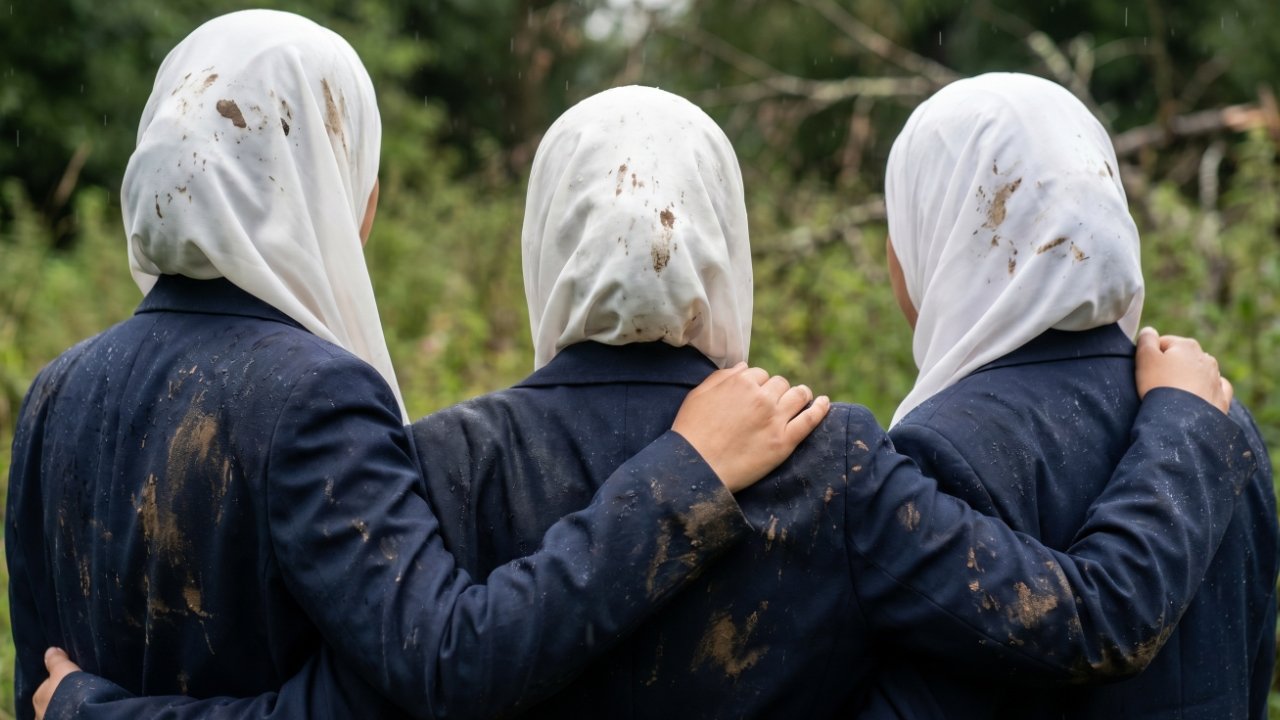
They come back muddy, exhausted, uncomfortable, and they remain this way through the afternoon debrief, through the processing and reflection and academic integration, because this extended discomfort is itself deliberate. You are teaching them what refugees already know: that there is no quick return to normal, that displacement disrupts not just the moment but everything that follows.
In the debrief you help them articulate what they have experienced, connecting their bodies’ knowledge to curriculum, to the geography of forced migration, to Islamic teachings about hijrah and responsibility toward the vulnerable, facilitating conversations about privilege and what their own comfort costs and who pays that cost elsewhere.
And through the discomfort and the reflection together, they discover they are capable of more than they believed: of persisting, of supporting classmates through shared difficulty, of completing challenges that seemed impossible when they began, which is knowledge that settles into how they understand their own capacities and responsibilities in ways that a certificate never could.
For leavers particularly
There is particular appropriateness to offering this challenge to students leaving your school, because they stand at the threshold between childhood and whatever comes next, able to sense approaching adult responsibilities they cannot yet fully grasp. This is liminal time, when young people are especially open to experiences that might reshape their understanding of themselves and their place in the world.
The Student Challenge offers ritual marking of this transition, not the comfortable rituals of awards ceremonies and yearbook signings, though those have their place, but something harder and therefore more memorable, something that demands they reach beyond their comfortable selves and discover what lies past the boundaries they have accepted as fixed.
They finish exams exhausted, minds full of facts and formulas and essay structures, ready for relief and for something entirely different, and the challenge provides exactly this: active where school has been sedentary, physical where studies were mental, immediate where preparation was abstract. It gives post-exam students what they desperately need: an outlet for accumulated stress and proof that they are capable beyond academic performance.
Meanwhile, it sends them forward with something more essential still: embodied understanding that their comfort is not universal, that their security is not guaranteed, that others their age face difficulties they cannot imagine. Through the experience they have learned to carry responsibilities as Muslims, as global citizens, as human beings with capacity for empathy and action, toward those whose lives are harder and whose futures are uncertain in ways these students’ futures, however anxious they may feel, are not.
The practical made profound
Yes, this requires planning, since parental consent must be secured whilst maintaining secrecy, risk assessments must be thorough, transport and venue must be arranged, and staff must be briefed. The logistics are real and demand attention. But do not let practical demands obscure the profound educational opportunity you are creating.
This is not simply an end-of-year activity or post-exam stress relief, though it serves both purposes well, but sophisticated experiential education carefully designed to create authentic learning through embodied experience, to develop empathy through approximation, and to teach lessons that cannot be taught through words alone.
When you stand at the end of the day watching students, muddy and exhausted and somehow lighter despite their fatigue, processing what they have experienced, you are witnessing education of the highest order. Not education that produces higher test scores, though those matter, but education that shapes character, develops conscience, and prepares young people not just for employment but for ethical citizenship, for lives of meaning rather than mere comfort.
The invitation before you
The blueprint provides everything needed: the structure, timing, teaching framework and practical guidance. What remains is your decision. It is more work than a conventional Year 11 send-off, requiring more planning and coordination and trust in the educational value of discomfort and surprise, but the learning it facilitates cannot be achieved through easier means.
Some lessons can only be lived and some empathy can only develop when the distance between self and other is bridged not through imagination alone but through the body’s own struggle with difficulties that echo, however inadequately, what others endure without choice or end.
Your students stand at threshold. The Student Challenge offers them one answer to the question of who they might become. Let them feel, just for a day, the edge of what others endure indefinitely. Let them discover their own capacity for resilience, and let them leave your school changed by having chosen temporary difficulty that opened their hearts to permanent struggles faced by others. This is education that matters, formation that lasts, and it is yours to offer, if you so choose.