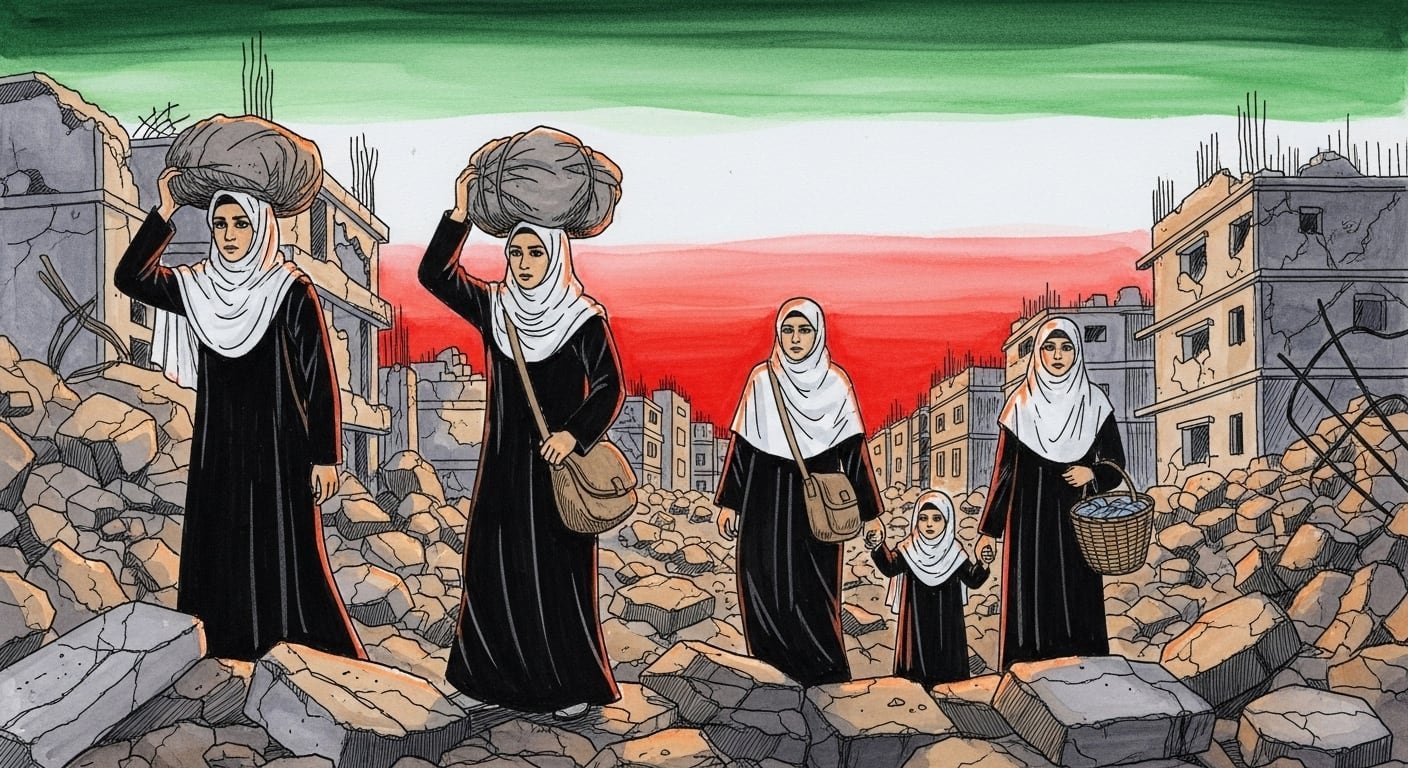
She carries her youngest child against her hip, the older one gripping her hand with fingers that won’t let go. Behind them, the sound of shelling grows fainter but never quite disappears. Ahead lies the river: swollen with monsoon rain, moving fast enough to sweep away anyone who loses their footing. Her abaya is already heavy with mud from the journey so far. The water will make it heavier still.
This is not one woman but thousands. Rohingya women wading across the Naf River into Bangladesh. Syrian women crossing the Mediterranean in boats that were never meant to hold so many. Palestinian women navigating rubble-strewn streets when violence erupts in Gaza. Afghan women fleeing Taliban rule through mountain passes. Sudanese women escaping civil war across borders they’ve never crossed before.
Each story is particular, shaped by specific conflicts and geographies. Yet certain elements repeat with haunting consistency: the mud, the rivers, the impossible distances covered on foot, the weight of modest dress becoming literal burden, the children who must be carried when they can walk no more, the terror of not knowing if safety actually exists anywhere ahead.
Rohingya women: when neighbouring countries become the only hope
In August 2017, violence against Rohingya Muslims in Myanmar escalated into what the UN would later describe as ethnic cleansing. Within weeks, more than 700,000 people fled to Bangladesh, the majority of them women and children.
The journey itself was an ordeal that filtered out the weak. Women walked for days through jungle terrain, many barefoot after losing shoes in the mud. They crossed rivers at night when border patrols were less vigilant, wading through chest-deep water whilst holding children above their heads, praying the current wouldn’t sweep them away. Some couldn’t swim but crossed anyway because staying meant death.
The monsoon season turned paths into swamps. Women’s longyi — the traditional wraparound skirt — became sodden and heavy, dragging through mud that sucked at every step. They climbed steep riverbanks whilst carrying infants, the earth crumbling beneath their feet, offering no purchase for hands already occupied with children and whatever possessions they’d managed to carry.
Many women reported being preyed upon during the journey — by smugglers demanding payment they didn’t have, by men who saw desperation as opportunity, by border officials who could grant or deny passage based on whim. The vulnerability was total. No papers, no money, no ability to appeal to authorities who viewed them as unwanted migrants rather than refugees fleeing genocide.
When they finally reached the camps in Cox’s Bazar, they found temporary shelter that has now lasted years. The camps sit on hillsides that become lethal during heavy rain; landslides have buried entire sections, killing families in their sleep. Women navigate narrow paths between shelters, balancing water containers on their heads, trying to maintain some shred of dignity in conditions designed to strip it away.
Yet they organise. They create informal schools when formal education is unavailable. They establish support networks, looking after each other’s children, sharing the meager resources distributed by aid organisations. They maintain prayer routines that anchor them when everything else has become unmoored.
Syrian women: crossing seas and continents
The Syrian civil war has displaced more than thirteen million people since 2011 — half the country’s pre-war population. Among them are millions of women who have crossed outstretched lands, seas, and multiple borders in search of safety that continues to elude them.
The journey to Europe often begins with a sea crossing that has claimed thousands of lives. Women board overcrowded boats with their children, paying smugglers everything they have for passage on vessels that are barely seaworthy. They wear life jackets that may or may not actually float. They sit for hours in the hull of fishing boats, unable to see the horizon, fighting seasickness whilst trying to keep children calm.
Some women give birth during these crossings. Others watch their children die from dehydration or hypothermia, unable to do anything but hold them. The sea does not care about maternal love or desperate prayer. It simply takes what it will.
Those who survive the crossing face the land journey through Europe, a marathon of walking that can last weeks. Women traverse muddy fields in Greece, climb over border fences in Hungary, walk through snow in the Balkans. Their abayas and long skirts become caked with mud, tearing on barbed wire, offering inadequate protection against cold. They sleep in parks and abandoned buildings, trying to shield children from the worst of it, knowing there is no shelter adequate to the need.
At every border, new obstacles appear. Closed crossings force detours through difficult terrain. Hostile populations make safety impossible even in supposedly safe countries. Authorities push them back across borders they’ve already crossed, forcing them to repeat journeys they barely survived the first time.
Still, they continue. They share food with strangers who are also fleeing. They carry each other’s children when exhaustion makes another step impossible. They find moments of levity even in camps where conditions are barely livable, because the alternative to laughter is despair, and despair is a luxury refugees cannot afford.
Palestinian women: displacement as inheritance
For Palestinian women in Gaza, displacement is not a singular event but a recurring pattern woven into family history. Many are themselves refugees or descendants of refugees from 1948 or 1967, living in camps that were supposed to be temporary but have lasted generations.
When violence escalates — as it does with grim regularity — these women know the drill. Grab children, grab documents if there’s time, flee toward anywhere that might offer shelter. The UN schools, relatives’ homes in theoretically safer neighborhoods, the southern regions of Gaza when the north is being bombed, Egypt if the border is briefly open.
They navigate streets filled with rubble, concrete dust coating their hijabs, covering their children’s faces so they can breathe. They step over downed power lines and around unexploded ordnance, carrying babies who are too young to understand why their mothers are running. The distances might not be as vast as those covered by Syrian or Rohingya refugees, but the terror is no less real, the uncertainty no less total.
For many Palestinian women, the abaya and hijab are non-negotiable. They are markers of identity and faith that they refuse to abandon even when fleeing. This means navigating rubble in long garments that catch on twisted metal, wading through flooded streets in clothing that becomes impossibly heavy when wet, climbing over barriers whilst maintaining modesty in situations where modesty seems like the least pressing concern.
Yet they insist on it. Because to abandon their dress would be to let the violence strip away not just their homes but their identity. The abaya becomes armor in a different sense: a refusal to let displacement define them entirely, a way of saying “you can force us from our homes but you cannot force us to become other than who we are.”
In temporary shelters — UN schools, mosques, relatives’ apartments — women create systems of communal living. They organise cooking rotations with limited supplies, establish childcare so mothers can rest in shifts, maintain prayer schedules that provide rhythm when everything else is chaos. They comfort each other’s traumatised children, knowing their own children need the same comfort but often too depleted to provide it.
Afghan women: when the homeland becomes prison
When the Taliban returned to power in August 2021, the terror for many was immediate. Women who had spent twenty years building fruitful lives, educating themselves, participating in public life, suddenly faced a regime that denied their basic humanity. Restrictions came swiftly: women banned from universities, from most employment, from traveling without male guardians, from existing in public space without complete covering.
Many fled. The lucky ones made it to evacuation flights, though even that required navigating crowds at the airport so desperate that people fell from planes after takeoff. Most had to take harder routes: overland through Pakistan or Iran, journeys that could take weeks and cost everything they had.
Women traveling without male relatives faced particular danger. The Taliban’s own forces posed threats at checkpoints. Smugglers demanded payment that might be monetary or might be something else entirely. Border guards could be bribed or could turn refugees back, and there was no way to know which until it was too late.
Those who reached neighboring countries often found themselves in camps or living illegally in cities, unable to work or access services, constantly at risk of deportation. The education and professional skills they’d spent years building became useless in contexts that offered no opportunities to use them.
Yet Afghan women organise even in refugee camps. They teach each other and their daughters informally, maintaining education when formal schooling is denied. They form support networks, sharing resources and information about which aid organizations can be trusted, which routes are safe, where to get medical care. They refuse to let displacement or oppression erase them.
Sudanese women: the forgotten crisis
Sudan’s civil war has displaced millions, yet it remains one of the least-covered humanitarian crises. The international community’s attention is elsewhere, which means the women fleeing conflict in Darfur, Khartoum, and other regions do so without the world watching, without the resources that sometimes follow media coverage.
These women walk for weeks to reach refugee camps in Chad or South Sudan. They travel through territory controlled by various armed groups, any of which might see unprotected women as targets. They cross rivers without boats, traverse deserts without adequate water, make choices no human should have to make about which children to carry and which must walk even when they’re too young or too sick to manage it.
Sexual violence during these journeys is common enough to be expected, horrific enough that many women don’t speak of it even when they reach safety. The trauma layers on trauma: violence that drove them from their homes, violence experienced during flight, violence that continues in camps where protection is inadequate.
Yet Sudanese women maintain their faith practices, finding ways to pray even when water for ablution is scarce, fasting during Ramadan even when daily food is insufficient, teaching their children Quran verses to preserve identity when everything else has been lost. The faith becomes anchor when the ground itself keeps shifting beneath them.
The thread that binds them
Across these different contexts — Myanmar, Syria, Palestine, Afghanistan, Sudan — the commonalities are stark. Women wade through water and mud in clothing never designed for such journeys. They travel distances that would be challenging for anyone and are nearly impossible for those carrying children, those who are pregnant, those who are ill. They face threats specific to being female in contexts where gender makes you target rather than simply human being in need.
They also demonstrate resilience that defies comprehension. They organise when systems collapse. They maintain cultural and religious identity when everything else has been stripped away. They protect children not just physically but psychologically, trying to shield them from the worst of what they witness. They form communities of mutual support when official aid is inadequate or absent entirely.
This is what refugees actually endure. Not statistics, not abstractions, not people who might have stayed home if they’d tried harder or been less cowardly. These are women who left because staying meant dying, who chose the slim possibility of safety over the certainty of violence.
Walking toward understanding
When you organise Trials & Tribulations, you are asking participants to taste — briefly and inadequately — what these women experience not briefly but constantly. The fasting mirrors the hunger of women who feed their children before themselves, who go days without adequate nutrition because aid distributions are irregular or insufficient. The muddy obstacles echo the terrain refugees must cross — not for a few hours but for days or weeks, not as a choice but as the only path between death behind and possible safety ahead.
The modest dress becoming heavy with water and mud is not metaphor but reality for women who wade rivers, cross borders in rain, navigate flooded camps. When your participants struggle with the weight of wet abayas, they touch the edge of what refugee women carry — not just physical weight but the burden of maintaining identity and dignity in circumstances designed to strip both away.
This is not equivalence. A few hours of chosen discomfort cannot match years of forced displacement. But it can transform abstract sympathy into something more embodied, more lasting, more likely to generate sustained commitment rather than momentary pity.
For those organising this challenge, conflict-driven displacement provides urgent focus for fundraising. The women whose stories are told above need material support. Organisations like Islamic Relief, Muslim Aid, UNHCR, Save the Children, and dozens of others work in camps and border regions, providing food, shelter, medical care, legal assistance, education, protection from violence.
When you run Trials & Tribulations with focus on refugees fleeing conflict, you create dual impact. The sponsorship funds flow toward organisations doing essential work. But equally important, you create awareness that persists beyond the challenge itself.
Many participants will know abstractly that wars create refugees. Few will have truly considered what that means in terms of physical ordeal — the rivers crossed, the distances walked, the hunger endured, the threats faced. The challenge creates visceral memory that changes how they engage with refugee issues going forward.
When news coverage shows images of women wading through water carrying children, participants will remember their own struggle through muddy obstacles. When reports mention refugee camps lacking adequate shelter, participants will recall being cold and exhausted after just a few hours and will multiply that by months or years. The challenge builds a bridge between comfortable lives and desperate ones, not erasing the distance but making it more visible, more felt, more demanding of response.
Building sustained solidarity
The wars will not end soon. Afghanistan remains under Taliban rule with no indication of change. Sudan’s civil war continues escalating. Syria has no peace in sight. The Rohingya remain unwelcome in Myanmar and unable to return safely. Palestinian displacement is both ongoing crisis and generations-old inheritance.
This means the need for support is not temporary but sustained. Refugee crises are measured in years and decades, not weeks. The women fleeing today will be rebuilding their lives — or still waiting in camps — for years to come.
Trials & Tribulations offers a tool for sustained engagement. When organised annually, it becomes a rhythm of remembrance and commitment, a communal practice that keeps refugee solidarity alive beyond news cycles and viral social media moments. Each year, new participants discover this embodied empathy. Previous participants deepen their understanding. The community as a whole builds muscle — both literal and figurative — for supporting those who continue suffering displacement.
Make clear to your participants: this challenge is not about you. It is not about personal achievement or fitness goals or collecting impressive social media content. It is about directing attention and resources toward women who need both. It is about refusing to let refugees become abstractions or statistics, insisting instead on their full humanity, their remarkable resilience, their absolute right to safety and dignity.
When sisters complete the challenge covered in mud, exhausted, hungry, let them sit with that discomfort long enough to remember it. Then help them see past it toward the women who don’t get to wash off the mud and return to comfort, who face the same struggles tomorrow and the day after and potentially for years.
This is the solidarity you’re building: not pity from safety but connection forged through deliberate discomfort, not charity as superiority but support rooted in recognition of shared humanity, shared vulnerability to forces beyond individual control. We are all one war, one disaster, one policy change away from becoming refugees ourselves. The only real difference is luck and geography.
Use this challenge well. Direct the funds where they’re most needed. Sustain the awareness beyond the event itself. Help your community see the women in the camps and on the journeys not as distant others but as sisters who deserve safety, dignity, and the possibility of futures beyond bare survival.
The women will continue fleeing war and persecution. The question is whether we will continue paying attention, whether our solidarity will outlast our initial emotional response, whether we’ll build the sustained commitment their ongoing displacement requires. May this challenge become part of building that commitment — one muddy obstacle course, one fasted trek, one community of participants at a time.