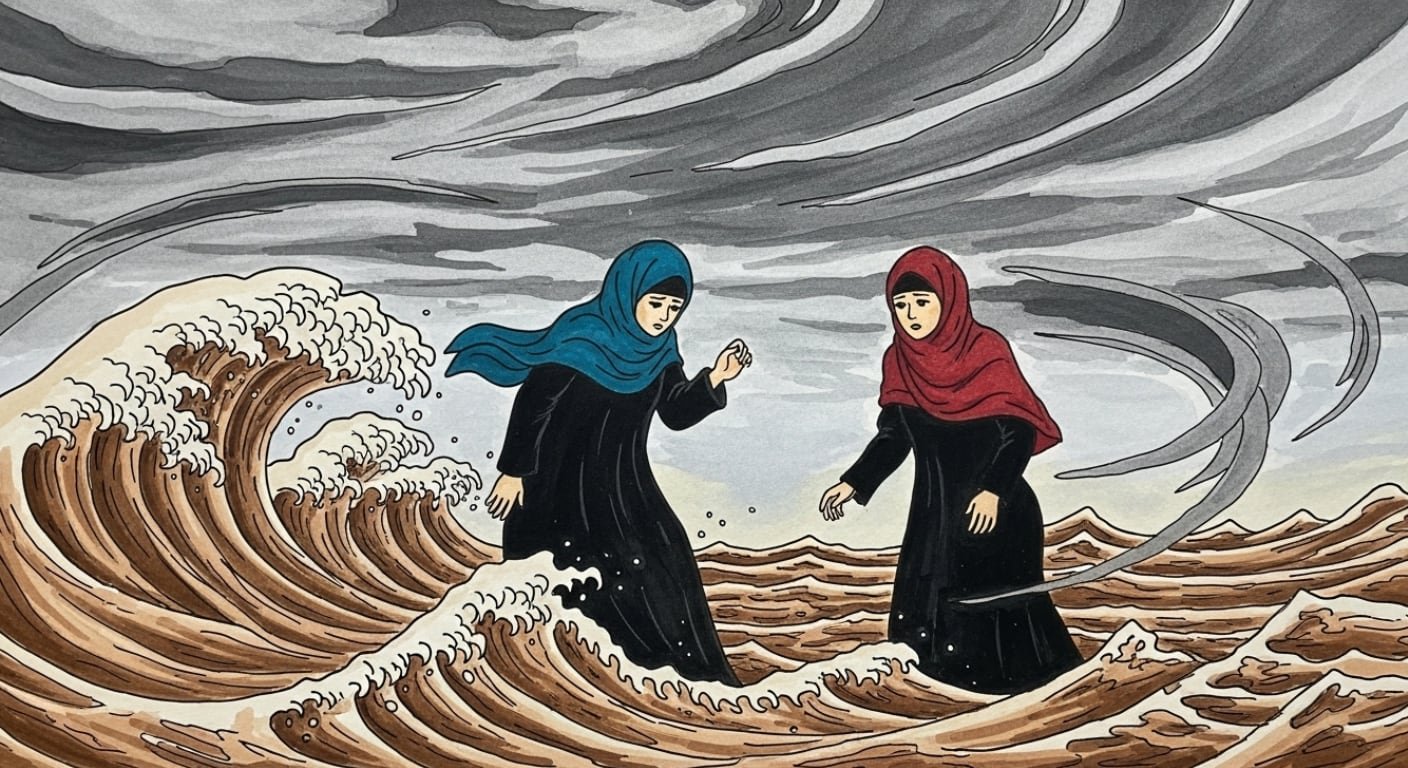
The monsoon rains arrive with a roar that drowns out prayer. Within hours, the water has claimed the ground floor, then the second storey, then everything. There is no time to gather possessions, only to grab children and flee — wading through currents that pull at your legs, your dupatta becoming a sodden weight that threatens to drag you under, mud sucking at your feet with each desperate step toward higher ground.
This is not metaphor. This is Tuesday in Pakistan during flood season. This is Friday in Bangladesh when the rivers breach their banks. This is any day in Yemen when cyclones strike a country already broken by conflict, or in Turkey when the earth suddenly decides to shrug and everything built upon it collapses.
For Muslim women caught in these disasters, the trials are both universal and particular — the same terror and loss everyone feels when nature turns hostile, amplified by the specific vulnerabilities of being female in contexts where protection and provision often depend on men who may themselves be dead, displaced, or simply overwhelmed.
Pakistan: when water erases everything
The floods come almost annually now, each year’s monsoon seemingly heavier than the last. Climate change has turned weather patterns erratic and vicious, transforming rain from blessing into curse. In 2022 alone, flooding displaced thirty-three million people across Pakistan — an almost incomprehensible number representing millions of individual catastrophes.
Picture the woman wading through chest-deep water, her shalwar kameez plastered to her legs, restricting movement whilst offering no warmth. She carries a child on her hip, another clutching her hand, trying to keep their heads above water whilst navigating debris that could be anything: broken furniture, dead animals, the remains of someone else’s life. Her dupatta, symbol of modesty and dignity, has become a liability, catching on submerged branches, weighing her down.
When she reaches emergency accompdation — if she reaches it — she finds conditions that mock the word “shelter.” Tents leak. Sanitation is a pit latrine shared by hundreds. Clean water is scarce despite the bitter irony of being surrounded by the flood that destroyed her home. Privacy is non-existent. The threats multiply: disease spreading through contaminated water, gender-based violence in the chaos where normal social structures have dissolved, exploitation by those who see disaster as opportunity.
Yet these women do not simply survive — they organize. Within days of arriving at camps, women create informal networks, sharing whatever resources exist, looking after each other’s children, establishing systems for safety and support. They become leaders not because they sought the role but because their families and communities need them to be.
Bangladesh: living on shifting ground
Bangladesh occupies some of the most vulnerable geography on earth: low-lying deltaic land where rivers meet the sea, where every monsoon brings potential catastrophe, where climate change manifests as rising waters and increasingly violent storms. The Rohingya refugee camps in Cox’s Bazar add another layer of complexity, with hundreds of thousands of people living in temporary shelters on hillsides that become lethal mudslides when heavy rain arrives.
The women here know mud intimately. It is what you walk through to fetch water, what covers your children’s feet, what makes every journey treacherous. When landslides strike — as they do with increasing frequency — entire sections of camps can be buried in minutes. Women flee carrying infants, pulling children behind them, slipping and falling and getting up and continuing because stopping means dying.
In the camps, women face impossible mathematics: not enough food, not enough clean water, not enough medical care, not enough safety. They must calculate which child eats today, whether to risk traveling to the distribution point where aid is available but harassment is likely, how to maintain any shred of dignity when washing, changing clothes, or managing menstruation becomes a public act in overcrowded conditions.
Still, they form support circles. They teach each other skills. They create small economies — sewing, cooking, childcare — that provide both income and purpose. They refuse to let disaster define them entirely, finding ways to maintain identity and community even in circumstances designed to strip both away.
Yemen: compounding catastrophes
Yemen teaches a harsh lesson about how disasters multiply. War has already displaced millions, destroyed infrastructure, created famine. Then the environmental disasters arrive — floods, cyclones, drought — each one hitting a population with no remaining resilience, no buffer nor safety net.
Women in Yemen often walk through floodwaters contaminated with sewage and chemicals, wearing niqab or abaya that becomes impossibly heavy when wet, navigating toward destinations that may no longer exist. They arrive at makeshift shelters to find nothing: no healthcare, no food distribution, no protection. The conflict makes humanitarian access sporadic at best, so these women often subsist on what they can gather or grow themselves, which in disaster conditions means subsisting on almost nothing.
The resilience required is staggering. These are women who wake each morning uncertain if their children will eat, if violence will reach them, if disease will spread through their overcrowded shelter, if the next storm will destroy what little remains. Yet they continue: caring for children, supporting neighbors, maintaining prayer routines that anchor them when everything else has shifted.
Community organisations do what they can, providing health services and education when possible, but the needs vastly outstrip available resources. The women themselves become the primary aid workers, the ones who know who needs help most urgently, who can be trusted with limited supplies, how to stretch impossibly small amounts of food across impossibly large needs.
Turkey: when solid ground betrays
Earthquakes offer no warning seasons, no time to prepare. The ground simply moves, and everything built upon it — homes, mosques, markets, lives — collapses. In Turkey’s earthquake zones, Muslim women have learned to dress so they can flee immediately if needed, to keep emergency supplies accessible, to know evacuation routes. But when disaster actually strikes, preparation means little against the chaos of crumbling buildings and blocked streets.
Women navigate rubble-strewn paths in whatever they were wearing when the earthquake hit — often traditional dress that wasn’t designed for climbing over debris or squeezing through narrow spaces. They search for family members, calling names into the wreckage, hoping for responses. They protect children from aftershocks that can trigger landslides or bring down already-damaged structures.
In the aftermath, temporary shelters spring up: tent cities or converted public buildings where women try to maintain some structure of normal life for traumatised children. They face the particular difficulty of maintaining modesty in temporary housing where walls are cloth and neighbors are strangers. They organise meal preparation with limited supplies, comfort children who have nightmares, support each other through grief whilst processing their own.
The thread that connects them
Across these different contexts — Pakistan, Bangladesh, Yemen, Turkey — certain patterns repeat. Women wade through mud wearing clothes that restrict movement. They navigate obstacles whilst fasting or on minimal food. They carry children and elderly relatives through terrain that offers no mercy to those who are burdened. They arrive at destinations only to find conditions that strip away dignity and offer minimal safety.
They are also consistently remarkable. They organise when systems collapse. They lead when leadership is absent. They find ways to maintain faith and community under circumstances that would justify despair. They demonstrate that resilience is not simply bouncing back but continuing forward even when there is no clear path, even when strength seems depleted, even when hope requires more courage than most of us will ever need to summon.
Walking toward understanding
This is why Trials & Tribulations asks participants to fast whilst navigating muddy obstacles in modest dress. Not to claim equivalence — a few hours of chosen discomfort cannot match years of forced displacement — but to move from abstract sympathy toward embodied understanding, however partial.
When your abaya becomes heavy with mud, you glimpse what women carry through floodwaters. When hunger makes the obstacles harder, you taste what it means to keep moving without adequate nutrition. When you’re cold and tired and the finish line seems impossibly far, you touch the edge of what refugees feel when there is no finish line, no guaranteed safety, no promise that struggle will eventually end.
For those organising this challenge, environmental disaster provides a particular focus for fundraising and awareness. The women whose experiences are described above need material support — funds for the organisations providing healthcare, clean water, shelter, and security in disaster zones. They also need the world to see them, to recognise their strength, to refuse the narrative that casts them only as victims.
When you run Trials & Tribulations focused on environmental disaster and displacement, you can partner with organisations working in Pakistan, Bangladesh, Yemen, Turkey, and dozens of other contexts where climate change is making disasters more frequent and severe. Islamic Relief, Muslim Aid, Human Appeal, and others all maintain disaster response programs. Global organisations like UNHCR and UNICEF work across multiple contexts. The DEC mobilises rapidly when major disasters strike.
But beyond fundraising, you’re creating awareness. Many participants will know abstractly that environmental disasters displace millions. Few will have truly considered what that displacement actually looks like — the mud, the hunger, the vulnerability, the impossible choices women must make whilst trying to protect their families.
The challenge transforms abstraction into something felt in muscles and bones. It creates memory that persists when news coverage fades. It builds commitment that outlasts the immediate disaster, because participants have touched — briefly and imperfectly — what these women endure not briefly but constantly.
This is the solidarity you’re offering to build: not pity from a distance but connection forged through deliberate discomfort, not charity as superiority but support rooted in recognition that we are all vulnerable to forces beyond our control, that any of us might need the help we’re now offering to others.
When you gather your community for this challenge, help them see the women walking through floodwaters, navigating landslides, fleeing earthquakes. Help them understand that their muddy obstacle course mirrors real terrain that offers no choice but to cross it. Help them recognise that their temporary hunger connects to real hunger that doesn’t end when the challenge is complete.
Then direct their sponsors’ funds and their sustained attention toward the organisations working to provide what these women desperately need: safety, dignity, resources to rebuild what disaster destroyed, pathways toward futures that hold more than bare survival.
The earth will continue shaking, the waters rising, the storms intensifying. Climate change ensures that environmental disasters will displace ever more people, that women will continue wading through mud carrying children toward uncertain sanctuary. The question is whether those of us who live in relative safety will maintain attention and commitment, or whether we’ll turn away once the dramatic footage stops appearing in our feeds.
Trials & Tribulations offers a tool for sustained engagement — an annual practice that keeps awareness alive, that generates ongoing support, that builds the muscle of solidarity alongside the physical muscles challenged by obstacles. Use it well.