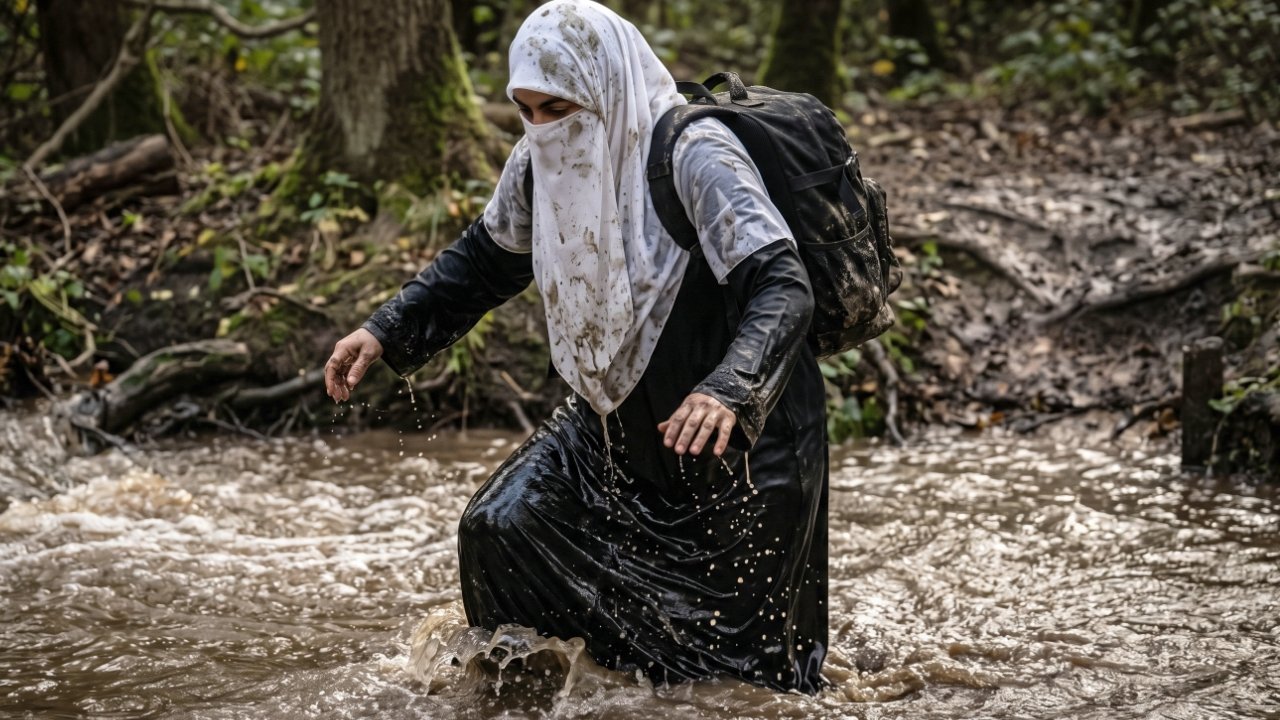
“That doesn’t sound very practical,” someone says, watching preparations for Trials & Tribulations — sisters adjusting abayas, ensuring hijabs are secure, checking that modest dress will hold against wind and obstacle and the hungry pull of mud. The observation is accurate. It is also beside the point.
Practicality is the privilege of those who have time to plan, resources to prepare, shops where specialised gear waits on shelves. Practicality belongs to scheduled challenges with known routes, to sponsored walks where the hardest question is whether to wear the new trainers or the broken-in ones.
Refugees fleeing for their lives have no such luxury. They run in whatever they wore that morning — the abaya donned for school drop-off, the dress chosen for marketing, the clothing of everyday life suddenly pressed into service for journeys that will test every thread and seam. This is the truth Trials & Tribulations asks you to remember, the reality your challenge makes tangible: that displacement does not wait for practical preparation.
What they carried, what they wore
Picture the Sudanese mother who woke one morning to the sound of approaching violence, who gathered her children and fled with nothing but what they wore and what she could carry. The dress that had seemed so ordinary hours before now catches on thorns as she navigates unfamiliar terrain, seeking the rumoured safety of Uganda or Egypt. Her shoes — chosen for a day of domestic tasks, not for crossing rocky wilderness — wear thin and fail. Still she walks, because stopping means capture or worse, because her children’s survival depends on movement no matter how ill-equipped she is for the journey.
The abaya that protects her modesty offers no protection from the elements. It grows heavy when rain falls, clings with mud at every river crossing, becomes both burden and lifeline — for she will not abandon it even as it makes each step harder. This is not stubbornness. This is dignity maintained when everything else has been stripped away. This is the insistence that she remains herself even as her world collapses around her.
When she finally reaches Uganda — exhausted, feet bleeding, dress torn but still intact — she confronts new terrain, rocky and unforgiving, without adequate support or supplies. What sustained her was not practical gear but something the well-equipped often forget they possess: the sheer necessity of survival, the resilience that emerges when there is no other choice.
The ones who fled through fire
Consider the Rohingya women who fled Myanmar with villages burning behind them, the smell of smoke clinging to the very clothes on their backs. They ran through forests, waded through rivers, hid from military patrols whilst carrying children too young to understand why the world had suddenly become so dangerous, hostile, and so utterly changed.
These women wore what they had worn that morning — modest dress chosen for a day that was supposed to be ordinary, unremarkable, safe. Instead they found themselves navigating treacherous landscapes, crossing waterways that soaked fabric and made every movement harder, all whilst trying to keep children quiet enough that soldiers would not hear them, calm enough that panic would not spread.
The journey to Bangladesh demanded everything they had and more. No technical fabrics to wick away sweat. No waterproof layers to shed the rain. No hiking boots designed for rough terrain. Just everyday clothing pressed into extraordinary service, just the body’s will to survive, just the fierce determination to see their children to safety no matter the cost.
The trauma they endured is unimaginable from comfortable distance. Yet they endured it. They kept moving when stopping meant death. They found strength in places they did not know strength could dwell. And they did it all in the clothing of everyday life — the dress, the hijab, the abaya that marked them as Muslim women even as the world sought to erase them entirely.
Why the abaya matters
When you organise Trials & Tribulations and insist that participants wear modest dress — abayas, hijabs, clothing that will catch on obstacles and grow heavy with mud — you are not being impractical. You are asking for honesty. You are requesting that the challenge reflect, however briefly, the reality faced by women who had no choice in their attire, no opportunity to optimise for performance, no chance to trade dignity for ease.
The sister who completes your course in full modest dress whilst fasting will understand what the refugee already knows: that the body can endure far more than the mind believes possible, that clothing chosen for modesty rather than practicality still allows for resilience, that strength is not diminished by fabric but revealed through it.
She will feel the abaya catch and cling, will know the weight of wet cloth against tired limbs, will understand in her muscles and bones what it means to persist when practical would mean giving up. This is not play-acting. This is embodied empathy: the kind that settles in the body’s memory, that cannot be easily forgotten once experienced.
The observers who question the practicality miss what you already understand: that this challenge is not designed for optimal performance but for truthful solidarity, not for personal records but for connection to those whose journeys were never about choice or comfort but about survival at any cost.
The resilience woven into cloth
There is a particular strength that emerges when we work with what we have rather than what we wish we had, when we persist despite disadvantage rather than only attempting what comes easily. The refugee women who crossed continents in everyday dress discovered this strength not because they sought it but because circumstance demanded it. They became unwitting teachers of what the human spirit can sustain when there is no alternative.
Your challenge allows participants to be willing students of this lesson. By insisting on modest dress, by making the journey harder than it needs to be in practical terms, you create space for a different kind of learning. One that happens in the body rather than the mind, one that cannot be gained through reading accounts or watching documentaries but only through doing, through struggling, through choosing difficulty that mirrors, however inadequately, the difficulties others had no choice but to face.
When the sister at your event stumbles in her abaya, catches herself, keeps moving, she is walking in the footsteps of countless women who stumbled and caught themselves and kept moving because their children’s lives depended on it. When she feels her modest dress grow heavy with rain and mud yet refuses to abandon it, she is honouring the dignity maintained by women who would not and could not let displacement strip them of everything, including their identity.
This is not impractical. This is profound. This is the difference between a sponsored walk and a threshold experience, between fundraising and transformation.
What you offer them
As an organiser, you will face questions about practicality. Some will suggest athletic wear would be more sensible, that performance fabrics would improve times, that surely modesty can be set aside for a few hours in the name of comfort and efficiency.
Hold firm in your response. Explain that comfort is not the goal. Efficiency is not the point. This challenge asks something different: that we briefly set aside our privileges — the privilege of choosing optimal gear, of planning for performance, of prioritising ease over authenticity — and walk instead in solidarity with those who had no such privileges, who faced journeys infinitely harder with resources infinitely scarcer.
The impracticality is intentional. The difficulty is the point. The modest dress that makes everything harder is precisely what makes the challenge meaningful, what transforms it from physical test to spiritual journey, from individual achievement to collective act of remembrance and solidarity.
Let the practical-minded raise their concerns. Answer them not with defensiveness but with invitation. To see differently, to understand that some truths can only be learned through the body, to recognise that the refugees who inspire this challenge survived not because they had practical gear but because they had no choice except survival.
Your participants will emerge muddy and exhausted, their abayas stained and heavy, their modest dress tested by every obstacle. They will understand in ways words cannot capture what it means to persist when practicality would suggest surrender, to maintain dignity when circumstances conspire to strip it away, to move forward when every practical consideration argues for staying still.
This is the gift of impracticality. This is what you offer them. This is why the abaya matters: not despite its difficulties but because of them, not although it makes things harder but precisely because it does.
May those who question find their way to understanding. May the sisters who walk your challenge discover the strength that dwells in places practicality cannot reach. May the impractical become, as it so often does, the pathway to what matters most.