When vision arrives
It begins with seeing, not just the surface idea of women walking through mud, but glimpsing what such a challenge might unlock. You envision sisters gathering on a Friday evening, spending the night in prayer and discomfort, rising before dawn to walk miles whilst their stomachs empty and their bodies protest. You see them supporting refugees not through distant charity but through embodied solidarity, and choosing difficulty when ease beckons.
This vision carries weight because you sense its potential for transformation. Not merely fundraising, though funds will be raised. Not merely awareness, though awareness will grow. Something deeper: a crack in the ordinary that allows light to enter: a threshold where comfortable lives meet uncomfortable truths, where empathy stops being abstract concept and becomes knowledge written in muscle and bone.
But vision alone accomplishes nothing. Between seeing what could be and watching it unfold in reality lies the hard work of making it so. This is your task as organisers: to translate possibility into actuality, to build the container in which transformation can occur, to shepherd others towards something they cannot yet imagine wanting.
Crafting the invitation
Your first consideration must be purpose made resonant. The concept exists: Trials & Tribulations, a challenge simulating refugee hardship through fasting, modest dress, and muddy obstacles. But how you frame this determines whether it remains curious idea or becomes irresistible call.
The challenge must be both impactful and accessible, daunting yet achievable. Too easy and it teaches nothing, inspires no one, and creates no space for discovery. Too extreme and you lose participants before they begin, asking more than bodies or spirits can reasonably bear. The line between these extremes requires discernment.
Frame the purpose by connecting it to what already lives in participants’ hearts. They care about refugees, yes, but perhaps abstractly, from a comfortable distance. Show them how this builds a bridge from sympathy to solidarity, from knowing about suffering to tasting its smallest measure. Help them understand that they will walk not for refugees but with them, in spirit, in struggle, in stubborn hope that refuses to look away from difficulty.
When the concept resonates and participants feel the tug of something meaningful calling them forward, recruitment becomes less about convincing and more about confirming what they already sense: that this matters, is worth doing, and will ask much but give more.
Finding those who will say yes
Initial enthusiasm may be elusive. Not everyone feels drawn to physically demanding challenges, especially ones that require fasting through exertion, that ask sisters to wear their finest clothes into mud, that span overnight with prayers on hard floors and dawn departures whilst exhaustion still clings.
Your recruitment requires both strategy and sensitivity, both persistence and patience. Begin with targeted outreach to those naturally inclined towards the challenge. Sisters already engaged in community causes understand service’s demands and rewards. Those drawn to physical activity recognise their bodies’ capabilities and trust their endurance. These early adopters become your foundation, and the ones whose enthusiasm can spark others’ interest.
Personal invitations carry power that general announcements cannot match. When you approach someone individually, not broadcasting to crowds but speaking directly to her, you communicate something invaluable: I see you, I believe you are capable of this, your participation would matter. People respond to being seen, to having their potential recognised by someone who knows them. One-on-one conversations allow for questions, concerns and hesitations to surface safely. The sister who seems dismissive in group settings may reveal genuine interest when given space for private honesty. You can address her specific worries, offer reassurance tailored to her circumstances, help her envision herself completing what initially seemed impossible.
Engage broader networks beyond individual outreach. When a husband nominates his wife, when a mother encourages her daughter, when an imam speaks approvingly of the challenge’s purpose, barriers begin crumbling. Families, community leaders and respected elders carry influence that amplifies your message. Nominations and endorsements create permission, and make participation feel not like isolated eccentricity but like communal endeavour worth joining.
When reluctance appears
You will encounter hesitation. Sisters who want to participate but fear they cannot, who doubt their endurance, who worry about being seen struggling or failing. Others will resist the entire concept: why would anyone choose difficulty, why make hardship when life offers enough already, why risk beloved garments in mud when simpler charity exists?
This is where your empathy becomes essential. Do not dismiss concerns or bulldoze past worries with forced enthusiasm. Listen deeply to what underlies the reluctance. Often it is not the challenge itself but fear of inadequacy, of embarrassing themselves, or of attempting something beyond their capacity and being diminished by failure.
Speak to these fears directly but gently. Explain that the point is not athletic prowess but solidarity, that there is no failure in struggling because struggle itself is the teaching. Remind them that refugees did not choose their difficulties either, that they walk not because they feel capable but because survival demands it. Draw parallels that make the abstract concrete. When refugees flee, they often walk for days whilst hungry, carrying what they can, wearing whatever they left home in. Your participants will walk for hours whilst fasting, carrying their own strength, wearing garments that connect them to something larger than themselves. The scale differs vastly, but the principle holds: choosing discomfort to understand others’ unchosen suffering.
Clear communication about logistics eases many concerns. Tell them exactly what to expect: the Friday evening gathering, the night catching rest on hard floors, the pre-dawn suhoor, the hours of walking and obstacles. Explain what support will be available: medical oversight, the option to modify or withdraw if truly necessary. Transparency builds trust, and trust opens the door to yes.
Building the experience
Your planning must balance immersion with wisdom. The challenge should simulate hardship authentically enough to teach, but not so extremely that it endangers or overwhelms. Design realistic obstacles that push without breaking. The muddy course, the long trek, the fasting: these combine to create genuine difficulty. But ensure the route remains navigable, that obstacles test without injuring, that distances challenge without exceeding what prepared bodies can manage. Provide clear safety measures, trained first-aiders, and protocols for emergencies. Your duty includes both enabling transformation and protecting those who trust you enough to participate.
Whilst simulating hardship, maintain certain basic comforts. Rest periods allow recovery without eliminating struggle. Hydration after iftar honours the fast whilst ensuring safety. The hard floor on Friday night teaches discomfort, but basic shelter protects from elements that would create danger rather than difficulty. These are not contradictions but wisdom: knowing the difference between challenging and damaging.
Inclusivity demands attending to participants’ diverse needs. Consider varying fitness levels, different body types, the realities of age and ability. Create space for modifications without shame, for honouring limitations without eliminating challenge. Some will complete the full course easily; others will struggle through every step. Both experiences are valid, both teach what needs teaching.
Fostering unity
Participants may arrive as individuals, but they should walk as community. The transformation Trials & Tribulations offers depends partly on shared struggle, on witnessing others’ strength when your own wavers, on being witnessed in your difficulty by those who understand because they too are enduring.
Foster camaraderie deliberately. Perhaps assign small groups for certain activities, creating bonds before the main challenge begins. Encourage mutual support: helping a sister through an obstacle, offering words of encouragement when someone falters, celebrating together when hard things are accomplished. These small acts of solidarity mirror the larger solidarity the entire challenge represents.
The Friday evening gathering and overnight stay serve this purpose as much as any other. Sisters pray together, eat suhoor together, lie awake on hard floors together. They share vulnerability: the tiredness, the discomfort, the uncertainty about what tomorrow holds. These shared experiences create connection that individual training could never build.
When the challenge itself begins and difficulty mounts, that connection becomes lifeline. The sister who wants to quit sees others continuing and finds her own strength renewed. The one who stumbles is helped up by those walking beside her. They discover that endurance is often communal: not just individual willpower but the strength we draw from one another, the refusal to give up partly because giving up means abandoning those who walk with us.
The power of symbols
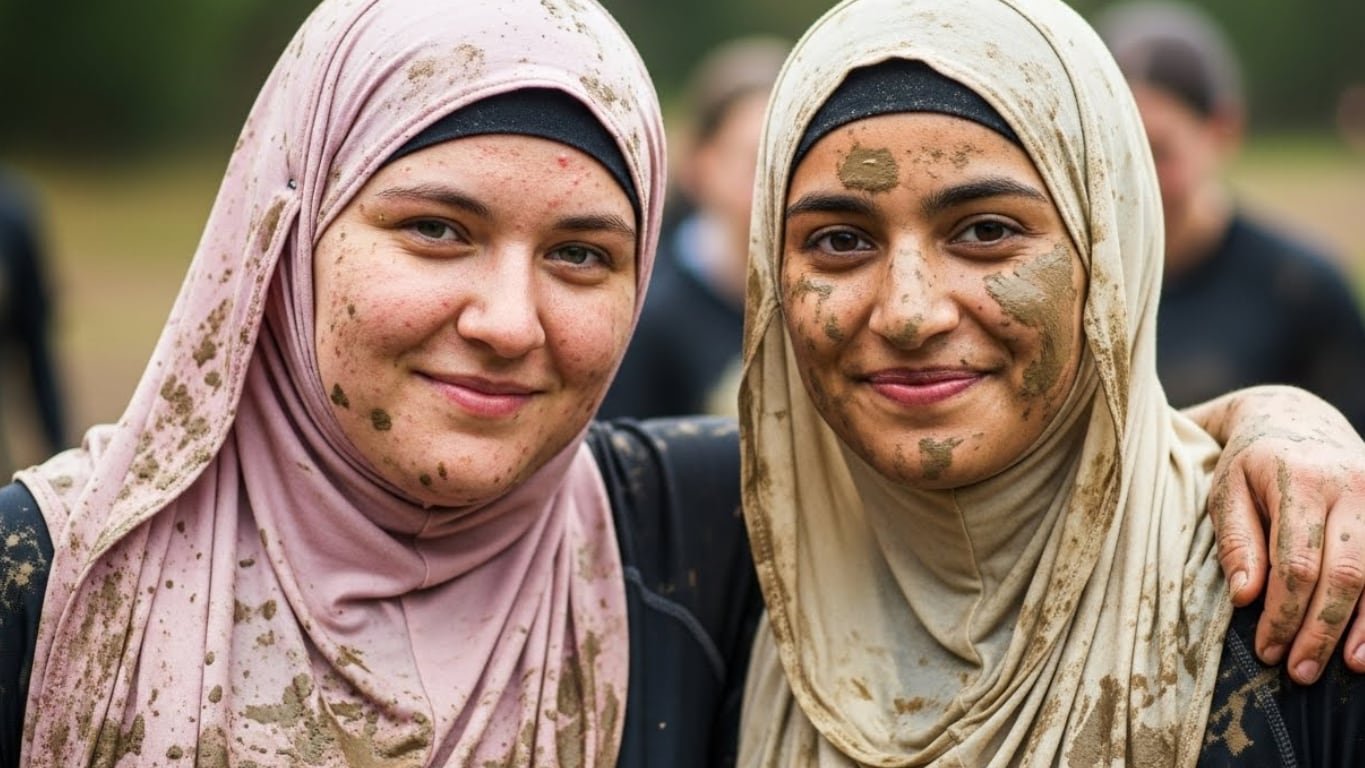
Everything about Trials & Tribulations carries symbolic weight, but none more than the choice of garments. When participants wear full Muslim dress, abayas and hijabs, the clothing that marks their faith and modesty, through mud and exhaustion, they make visible what often remains hidden.
They demonstrate that identity and values need not be sacrificed to difficulty. Refugee women maintain their dignity, their faith, their commitment to modesty even as they flee danger and endure deprivation. Your participants embody this same refusal to be stripped of what matters most. The abaya that becomes muddied and torn teaches that garments may be damaged but the person within remains whole, that external circumstances cannot touch the soul’s core unless we surrender it.
Encourage those who can bear it to wear treasured garments; this amplifies the teaching through heightened attachment and loss. But honour those who choose otherwise as well. Every sister in modest dress walking through that course teaches something essential about strength, solidarity, and the visible markers of faith enduring through trial.
These symbols work on observers as much as participants. Those who witness sisters completing difficult obstacles in flowing abayas, who see hijabs remaining carefully wrapped despite mud and sweat, absorb truths that truly transcend words. Strength takes many forms. Faith need not be set aside to meet challenges. Muslim women are not fragile creatures requiring protection from difficulty: they are capable, resilient, willing to walk into hardship for purposes larger than themselves.
After the finish line
The challenge concludes but the work continues. Transformation requires integration, needs time and space to settle from immediate experience into lasting understanding. Your role includes creating opportunities for this processing.
Facilitate reflection soon after completion, perhaps that same evening or the following day. Gather participants to share their struggles, their moments of doubt, their discoveries about their own capabilities. Let them speak of their exhaustion and triumph, their grief over ruined garments and pride in having endured. These shared testimonies deepen individual learning and strengthen communal bonds.
But do not limit processing to immediate responses. Some truths need distance before they can be articulated. Create space weeks or months later for participants to reflect on how the experience continues shaping them. What stays with them? How has their understanding of refugees evolved? What did they discover about themselves, about faith, about solidarity?
Highlight tangible outcomes as well. Funds raised, awareness generated, connections made with refugee organisations or communities. Participants need to know their suffering, small and chosen though it was, contributed to something beyond personal growth. That their discomfort had purpose, and their sacrifice meant something, their witness rippled outward in ways they cannot fully see.
Share stories of impact. If funds helped resettle a family, tell that story. If awareness led to policy changes or increased support, document it. If participants themselves changed, becoming more engaged with refugee causes, shifting their priorities, discovering capacities they now apply elsewhere, celebrate these transformations. This reinforces the value of what they endured and encourages future participation, both their own and others’.
What you must carry
Organising Trials & Tribulations demands persistence when initial enthusiasm lags, creativity when obstacles arise, adaptability when plans require adjustment. This is not simple event management but spiritual architecture, building containers where transformation becomes possible, where ordinary people encounter extraordinary truths, where comfortable lives crack open to make space for solidarity with those who suffer.
You will face challenges during planning and execution. Potential participants will decline. Logistics will prove more complicated than anticipated. Weather may threaten, resources may fall short, the countless small details that must align for success may resist alignment. Do not interpret these difficulties as signs that your vision lacks merit. Worthwhile endeavours rarely unfold smoothly, and resistance often signals that something meaningful is trying to emerge.
Engage community support broadly. You cannot do this alone, nor should you attempt to. Others carry skills you lack, perspectives you need, energy that replenishes your own when exhaustion arrives. Build a team that shares the vision, delegate freely, and trust others’ capabilities. The challenge itself teaches about communal strength; let your organising embody this same principle.
Remain flexible enough to adapt without abandoning core purpose. If certain logistics prove impossible, find alternatives. If participation lags, adjust recruitment strategies. If weather demands schedule changes, adjust. But do not compromise the essential elements: the overnight gathering, the fasting, the muddy obstacles, the full modest dress. These create the conditions for transformation; without them, you have something easier but less impactful.
The invitation you extend
When you organise Trials & Tribulations, you offer something rare and necessary: a threshold between comfortable life and uncomfortable truth, between knowing about suffering and tasting its smallest measure, between sympathy maintained at safe distance and solidarity requiring sacrifice. You invite sisters to discover strengths they doubted they possessed, to connect with refugees not through abstract charity but through embodied empathy, to prove to themselves and their communities that Muslim women are capable of extraordinary things.
The sisters who participate will be changed by what you create. They will walk into Friday evening as one kind of person and emerge from Saturday carrying knowledge no lecture could impart. They will understand in their bodies what it costs to walk whilst hungry, to maintain dignity whilst exhausted, to continue when everything argues for stopping. They will carry this understanding forward into lives that may never be quite the same again.
And you: you will have made this possible. Not by forcing or manipulating, but by seeing what could be and working patiently, persistently and creatively to bring it into being. By holding the vision steady when others doubted. By attending to countless details that individually seem small but collectively create the container where transformation occurs. By believing that ordinary women are capable of extraordinary solidarity, and then proving this belief through what you build.
May your efforts bear fruit. May the thresholds you create welcome many sisters into transformation. May the work demand much of you and give more in return. May you discover, as those you serve will discover, that we are all stronger than we know, and that strength multiplied through community can move mountains, shift understanding, and build bridges where walls once stood.